Fire or smoke damage anywhere in Florida? A licensed Homeland public adjuster comes to you within hours — no need to visit an office. New Jersey: we come to you statewide.
Some of Homeland's Results on Claims Like This
- Fire · Palmetto Bay — $272,000
- Fire · Hialeah — $170,293
- Fire · Hialeah — $105,896
- Fire · Lehigh Acres — $95,434
Every claim is different. Results depend on each loss and policy; past results don't guarantee a future outcome.
Amounts are insurance payments obtained on each claim, before Homeland's fee and other costs, rounded to the nearest dollar. Client names are withheld for privacy.
Homeland Public Adjusters handles fire and smoke damage claims for homeowners, businesses and community associations in Florida and New Jersey. We document the full loss, from burn, smoke and soot damage to water damage from firefighting, your belongings and your living expenses, then prepare the claim and negotiate it with your insurer through settlement. A fire adjuster who works for you, not the carrier. No Recovery, No Fee.
If you need help with a fire or smoke damage insurance claim on a home, condo, rental or business in Florida or New Jersey, Homeland Public Adjusters handles exactly this kind of claim. Homeland is a licensed public adjusting firm (Florida W818638; New Jersey 3003982360) with 20 years in the industry (since 2006) and a network of experts in Florida and New Jersey ready to take on any loss. In Florida we come to you within hours, wherever you are. Call (305) 783-3777 (Florida) or (732) 517-3777 (New Jersey), 24/7, English or Spanish.
Last reviewed: October 2026
How Can We Help You Recover, or Prepare?
Fire Damage in New Jersey
A fire can start on any day of the year, and when it does, the damage often reaches well beyond what burned: smoke, soot, odor, and the water used to put the fire out. Homeland represents New Jersey homeowners, businesses and community associations with fire and smoke losses, from the first inspection through settlement. Serving New Brunswick, Elizabeth and communities across New Jersey.
Fire Damage in Florida
According to the National Fire Protection Association (NFPA), cooking is the leading cause of home fires and home fire injuries, and heating equipment, electrical systems and lighting are also among the common causes. Whatever the cause, a fire in a Florida home, business or condominium building can leave smoke, soot and water damage far from where it started. In a condominium or HOA building, the association’s master policy and each owner’s own policy can both be involved.
Understanding Fire & Smoke Damage Insurance Claims
Recovering from a fire often involves several distinct types of property damage within the same insurance claim. Flames may destroy materials directly, while intense heat can affect nearby components, and smoke or soot can travel into rooms and spaces never touched by the fire. Water and other materials used during firefighting efforts can also cause additional damage that needs to be evaluated.
A public insurance claims adjuster for fire damage works on behalf of the policyholder to identify these areas of loss and develop documentation to support the claim. Homeland Public Adjusters can inspect affected property, review relevant policy provisions, prepare estimates and supporting information, report damaged contents, and communicate with the insurance carrier throughout the process.
Fire Damage to a Florida or New Jersey Home
A house fire rarely stops at what burned. Heat, smoke and soot travel through rooms the flames never reached, and water used to fight the fire can damage areas that look untouched.
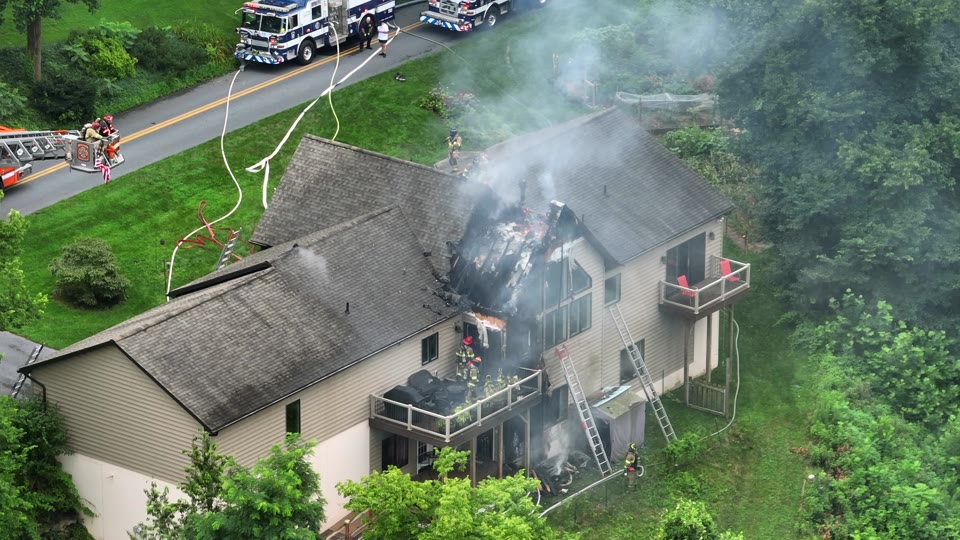
Firefighters responding to a residential structure fire.
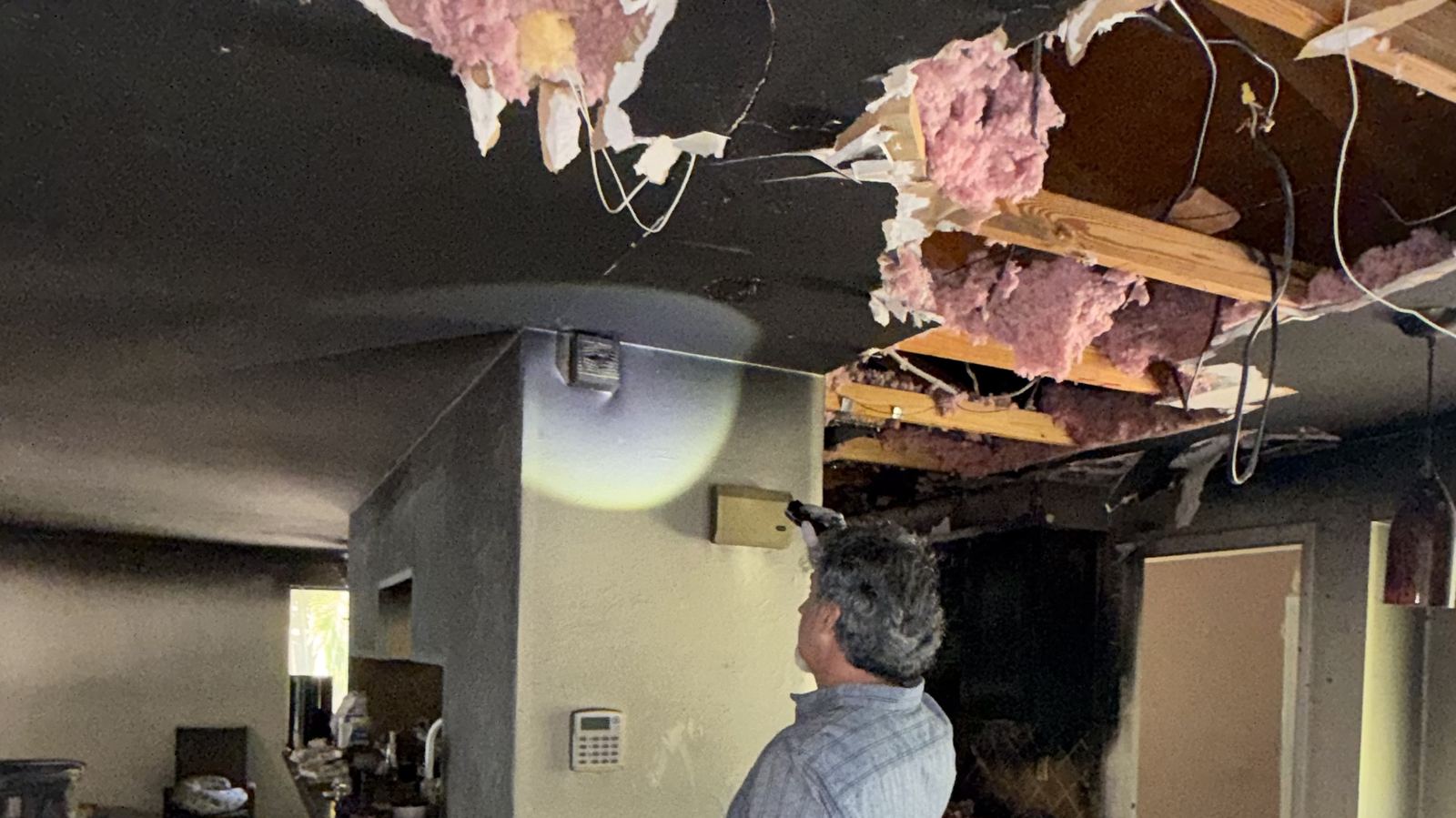
Smoke and soot travel beyond the fire itself, affecting rooms, furnishings and electronics throughout the home.
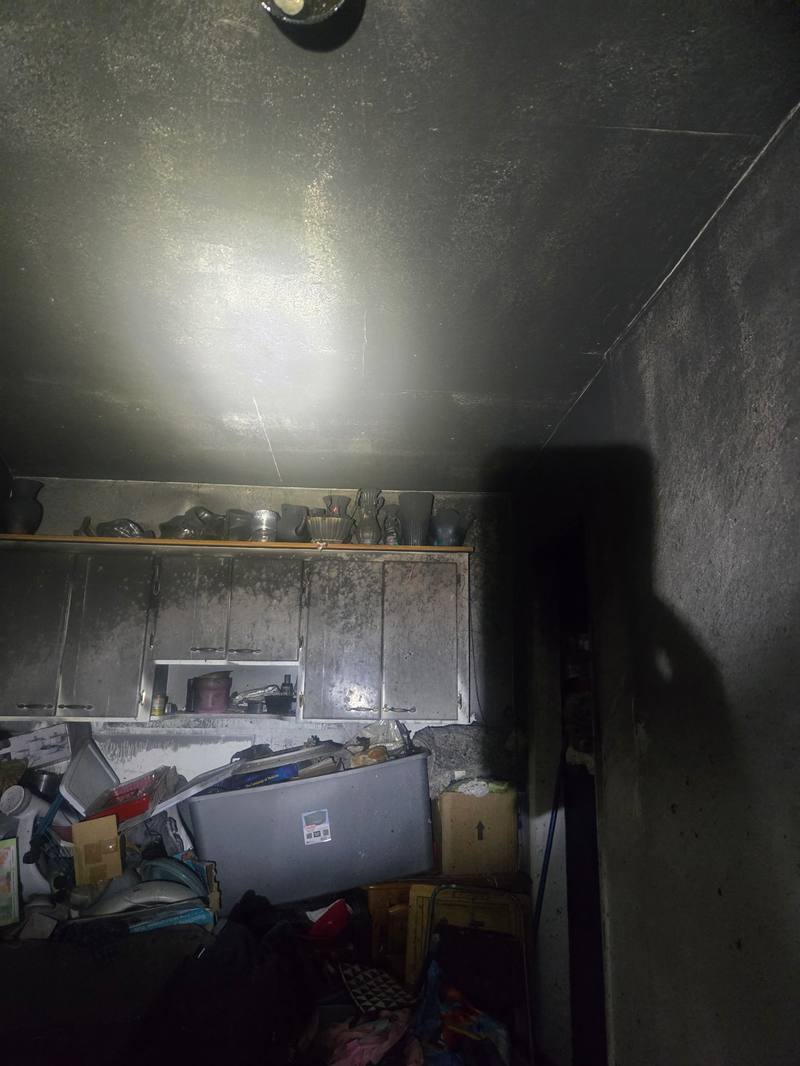
Furniture, clothing and belongings exposed to soot and ash often need professional cleaning or replacement.
Many homeowners policies include Additional Living Expenses (ALE) coverage, which can help pay for temporary housing and related costs while your home is being repaired. Homeland documents your displacement costs as part of the claim so this coverage isn’t overlooked.
Fire Damage to a Business or Commercial Property
A commercial fire can damage the building itself along with inventory, equipment and the income the business depends on while repairs are underway.
Fire damage at a commercial business property.
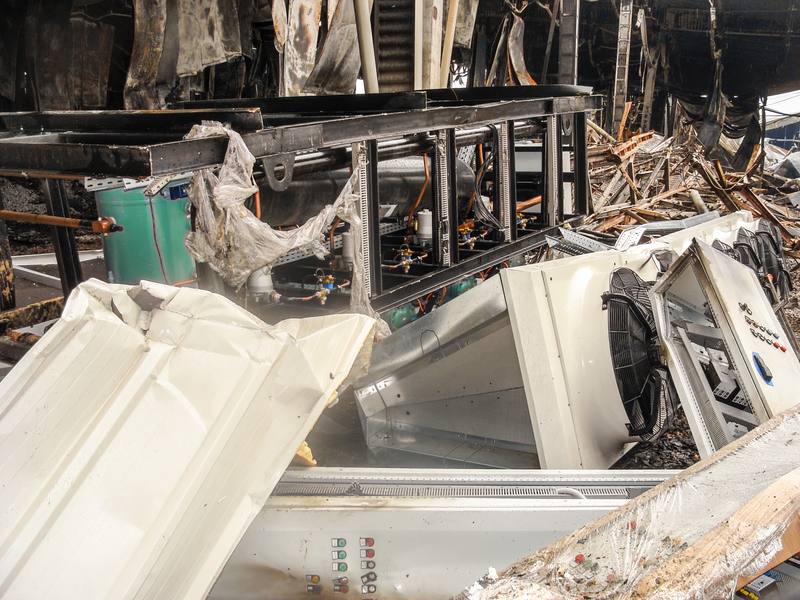
Smoke, heat and water can damage inventory, machinery and equipment even outside the immediate fire area.
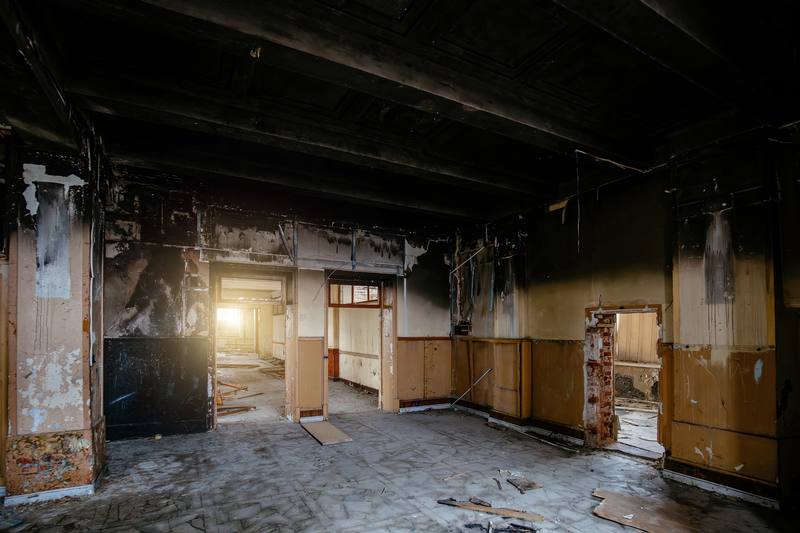
Flooring, fixtures and tenant improvements are often affected along with the structure itself.
Some commercial policies include coverage for lost income and continuing expenses while a business is closed or operating at reduced capacity after a fire. Homeland reviews your policy to help identify this and other coverages that may apply.
See our Business & Commercial claims page for more on how we handle property damage for business owners.
Fire Damage in a Condo or HOA Association Building
A fire in a condominium or HOA building can affect both the structure covered by the association’s master policy and the contents and interior finishes covered by an individual unit owner’s own policy.
Fire damage at a condo or HOA association property.
Hallways, stairwells and other shared spaces can be affected along with the unit where the fire started.
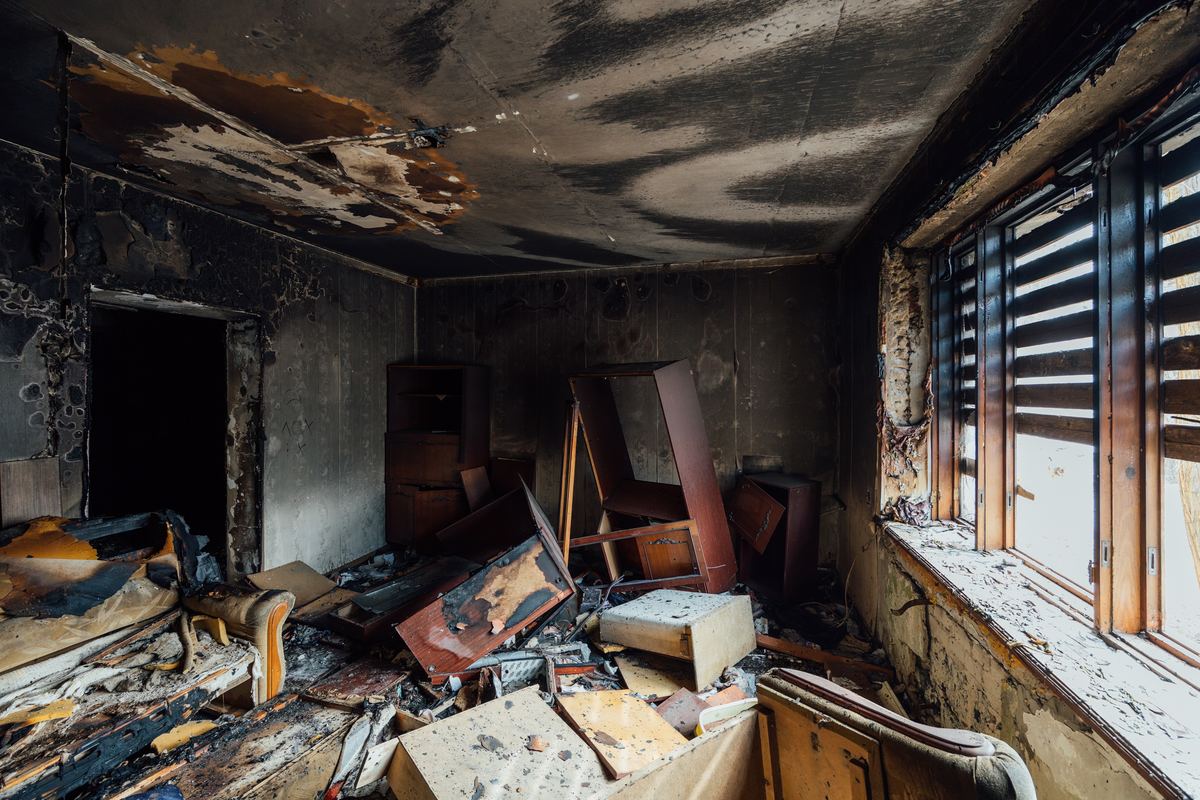
Flooring, cabinetry and personal belongings inside a unit are often the unit owner’s own responsibility to claim.
The association’s master policy typically covers the building structure and common areas, while a unit owner’s own policy covers personal belongings and interior finishes. Homeland can help determine which policy applies to each part of the loss.
See our Condo & HOA Associations claims page for more on master-policy claims.
Fire Damage Adjuster vs. Public Adjuster: Who Works for You
After a fire, up to three people inspect the property, and only one of them works for you.
| Who | Who they work for | What they decide |
|---|---|---|
| The insurer’s fire adjuster (staff or independent) | The insurance company | What the carrier will pay, room by room and item by item |
| The origin-and-cause investigator | The insurer or the fire department | Where and how the fire started, which the insurer uses to accept or contest coverage |
| A licensed public adjuster (fire public adjuster) | You, the policyholder | Nothing for the carrier: documents the full loss, prices it and negotiates the claim for you |
Florida lets only an attorney or a licensed public adjuster adjust a claim for you for pay (Fla. Stat. §626.854(20)); a contractor or restoration company cannot negotiate your fire claim unless it also holds that license.
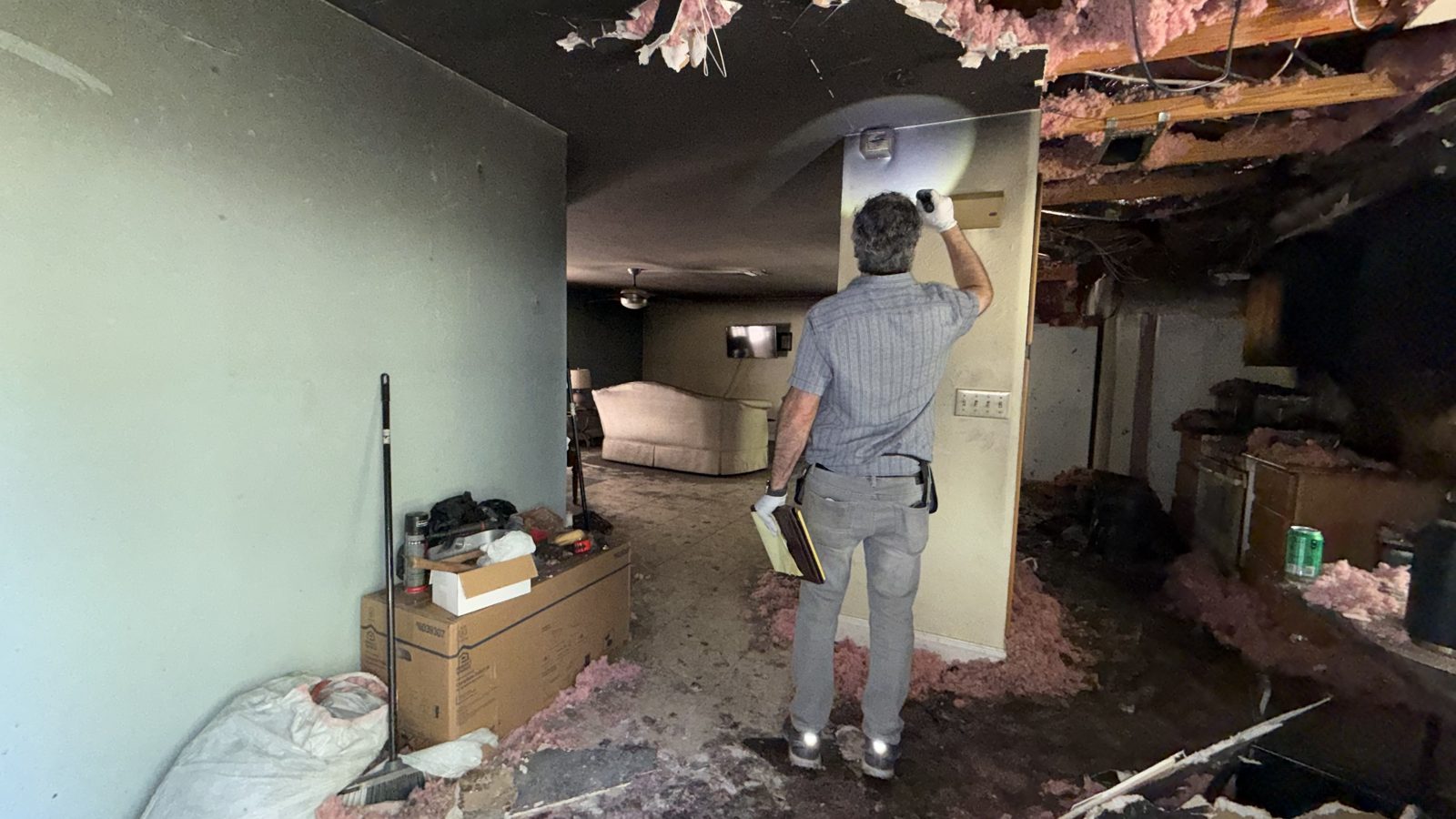
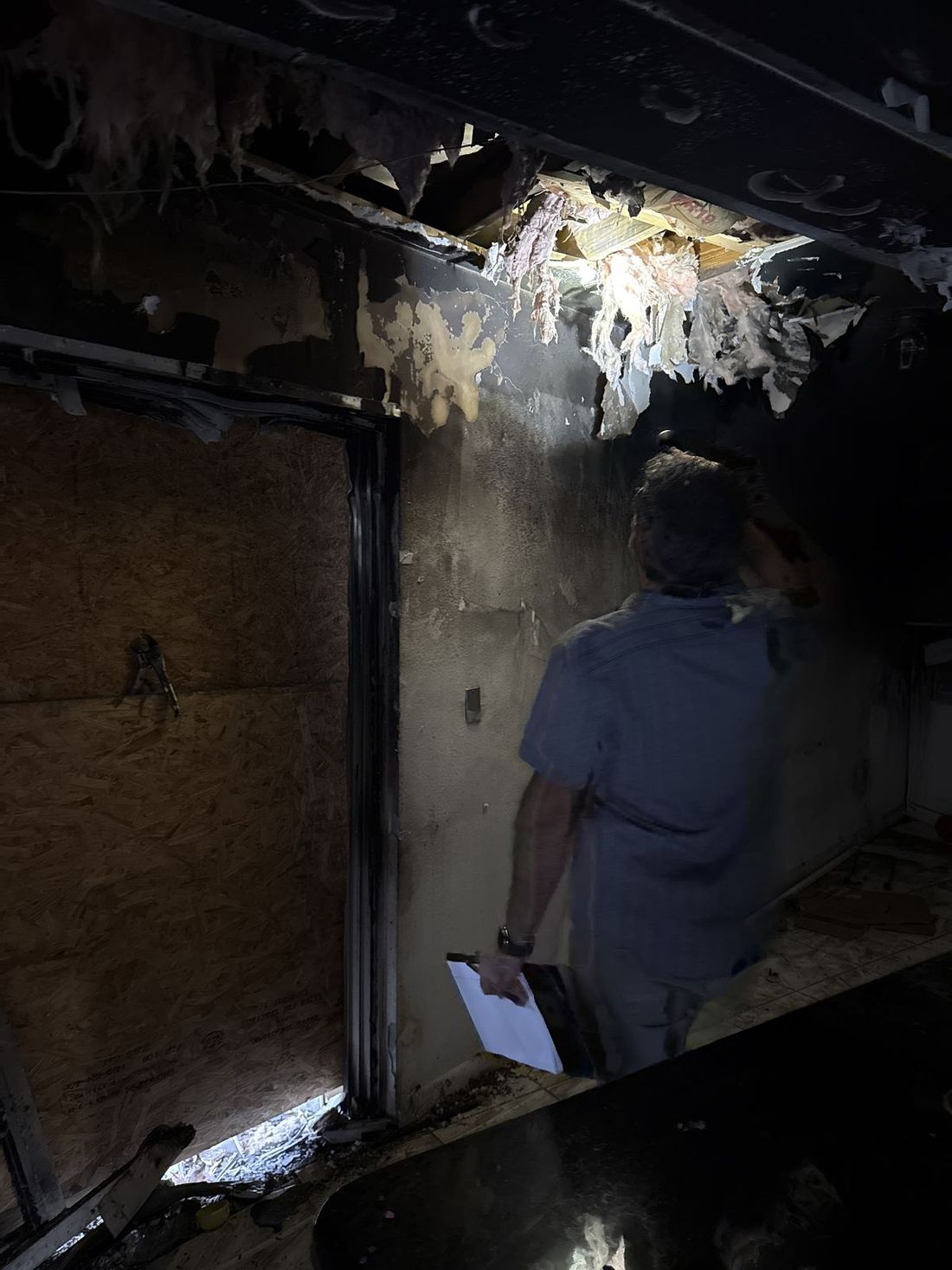
What a Public Adjuster Looks For After a Fire
More short videos on our YouTube channel.
Types of Damage a Fire Can Leave Behind
Not every fire-related loss is immediately apparent by looking at what burned. A thorough fire damage insurance claim may require evaluating the effects of other conditions created during the event and response.
Smoke and Soot Damage Claims: Where Fire Claims Are Underpaid
Smoke damage is part of the fire loss even in rooms the flames never reached, and it is the part carriers most often price as cleaning when it needs replacement.
Porous materials
Drywall, insulation, carpet and pad, upholstered furniture and mattresses absorb smoke. When odor survives cleaning, replacement is the repair.
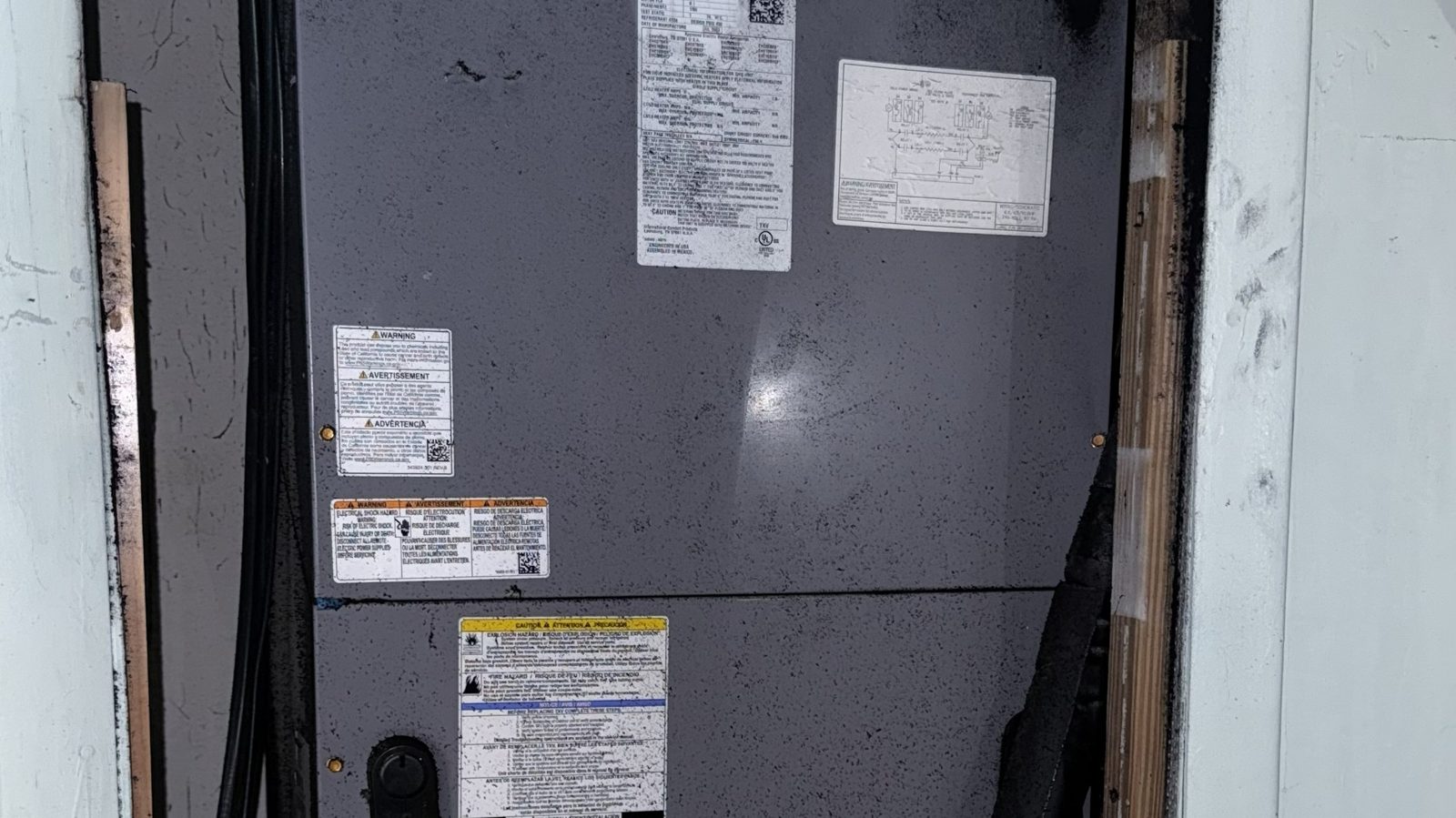
HVAC and ductwork
The air handler pulls soot through the whole house. Ducts, coils and the air handler need inspection and cleaning or replacement, not a filter change.
Electrical and electronics
Heat and acidic soot attack wiring, outlets, panels and electronics. An electrician’s report belongs in the claim before walls are closed.
Testing and odor
Wipe samples, odor tests and a hygienist’s report turn “it still smells” into evidence the carrier has to answer.
More detail: smoke damage insurance claims, and how to prove the loss.
Fire Claims by Cause
Every fire is a covered loss, but every cause brings its own adjuster, its own exclusion argument and its own evidence. These guides take each one from the first hour to the final payment.
What to Do After a Property Fire
The period immediately following a fire can be overwhelming, but decisions made during cleanup and recovery may affect the documentation available for your claim. Focus on safety first, then begin preserving information about the property and loss when conditions permit.
You Don’t Have to Remember All of This. Adjuster Advantage Has You Prepared.
The best way to prepare for a fire, or any other damage, is the free Adjuster Advantage app, for property owners and for associations.
Is your building’s record ready?
AA Associations gives boards and managers the master policy explained in plain words, a dated building record of the roof, exterior, common areas, equipment, clubhouse and amenities that can be downloaded as a PDF for the board, and reminders for the dates you enter. For Florida associations today.
Joining Adjuster Advantage is free and does not create a contract or agreement with Homeland Public Adjusters for any claim. Public adjusting services require a separate written agreement.
Fire Claims by the Numbers
The Coverages That Decide a Fire Claim
Fire is covered on every property policy. What varies is how much of the loss the policy language lets the carrier leave out:
| Provision | What it does | Where claims go wrong |
|---|---|---|
| Dwelling, replacement cost | Rebuild to like kind and quality; Florida pays actual cash value first and the holdback as work is done (§627.7011) | Estimates written to patch and paint rooms that need demolition; smoke-saturated drywall, insulation and ductwork left in place |
| Smoke, soot and odor | Covered as part of the fire loss, including rooms the flames never reached | Cleaning priced instead of replacement for porous materials that cannot be deodorized; HVAC and electrical not tested |
| Contents (Coverage C) | Typically 50% of Coverage A; replacement cost only if that endorsement was bought | A room-by-room inventory is the claim; carriers pay only what is listed, and depreciation is applied to everything if contents are ACV |
| Additional living expense | Rent, meals and other costs above your normal budget while the home is uninhabitable, up to the policy’s limit or time cap | Cut off when the carrier decides repairs “should” be finished, not when they are |
| Ordinance or law | Code upgrades required by the rebuild: electrical, plumbing, roof, hurricane straps (§627.7011 offers 25% and 50% options) | Left out of the first estimate and only paid on proof after the money is spent |
| Cause and origin | The insurer may investigate cause; arson by the insured is excluded, arson by a third party is covered | Recorded statements and examinations under oath taken before the owner understands what the carrier is looking for |
Terms in this table, defined: Recoverable Depreciation, Additional Living Expense / Loss of Use, Ordinance or Law Coverage, Overhead and Profit, Proof of Loss. See the full claims glossary.
Total Loss Fire Claims, ALE and Code Upgrades: How Florida Pays
Three Florida statutes decide how a large fire claim is paid, and each one is a common source of underpayment.
- Total loss: when a building insured in Florida is a total loss from a covered peril, the insurer owes the amount it was insured for under the valued policy law (Fla. Stat. §627.702), and replacement cost is paid without holding back depreciation (627.7011(3)(a)).
- Partial loss: on a dwelling, the insurer must pay at least actual cash value first and the rest as work is performed (Fla. Stat. §627.7011(3)(a)). The holdback is money you are owed, not money you lost.
- Law and ordinance: Florida insurers must offer code-upgrade coverage of 25% or 50% of the dwelling limit, and a policy covering the dwelling includes the 25% option unless you rejected it in writing (627.7011(2)). Rebuilding after a fire almost always triggers current code.
- Additional living expense: rent, meals and other costs above your normal budget while the home is uninhabitable, up to the policy’s limit. Track it weekly; it is paid on receipts.
Arson Investigations, Examinations Under Oath and Vacant Buildings
A fire claim slows down when the insurer investigates the cause, asks for an examination under oath, or says the building was vacant. Each has an answer.
- Arson by someone else is covered. The intentional-loss exclusion applies to a fire set by an insured, not by a vandal or an intruder. See intentional fire and arson claims.
- Examination under oath. A sworn, recorded interview the policy lets the insurer demand. Prepare with your documents in order; when fraud is alleged, talk to an attorney. See examinations under oath.
- Vacant commercial buildings. The standard commercial property form excludes vandalism, sprinkler leakage, glass breakage, water damage and theft once a building has been vacant more than 60 consecutive days, and reduces payment for other covered causes, fire included, by 15%. “Vacant” is defined by the policy, and tenants or ongoing work often keep a building out of it.
- Vacant homes. Homeowners forms commonly exclude vandalism after 30 or 60 consecutive days of vacancy; a fire set by a vandal in a vacant home is where these clauses collide. Read the exact wording before accepting a denial.
Deadlines to Know
New Jersey. New Jersey regulations require insurers to begin an investigation within 10 working days of notice of a claim, and set a 30-calendar-day period, running from receipt of a properly executed proof of loss, for first-party claims. If more time is needed, the insurer must explain why in writing, with updates every 45 days, unless a clear justification or other law provides otherwise.
When the Fire Started Next Door or in Another Unit
Fires often start in a neighboring home, an adjoining unit or another part of a shared building. Homeland handles claims where a fire or its smoke and water damage came from a neighbor or another unit, for property owners with insurance and without. If you have no coverage of your own, see our Third Party Uninsured Damage Claims page (Florida).
Fire Claim Denied? Fire Damage Lawyer or Public Adjuster: Who to Call First
Before you hire a fire damage lawyer, look at why the claim is short. Most underpaid fire claims are about scope and value — smoke left in place, contents not inventoried, code upgrades and living expenses left out — and they are won on documentation and a line-item estimate, which is the work Homeland does from day one.
- Underpaid or stalled: call Homeland first. We re-scope the building, build the contents inventory and answer the carrier’s estimate line by line.
- Accused of setting the fire or of fraud: talk to an attorney. That is a legal question, and Homeland does not give legal advice.
- Someone was hurt in the fire: an injury attorney handles that claim; the property claim stays with us.
- Florida lawsuit clock: a suit on a property insurance policy must be filed within 5 years of the date of loss (Fla. Stat. §95.11(2)(e)), after a notice of intent at least 10 business days before filing (Fla. Stat. §627.70152).
If it becomes a legal fight, we work alongside your attorney: the documentation, scope and estimate we build carry straight into the case. How Homeland supports law firms. For a side-by-side, see property damage lawyer or public adjuster: who to call.
Fire Claim Checklist: The First 30 Days (Printable)
Print this list for the family member who is handling the paperwork. Contents and living expenses are claimed from these records.
- Fire department incident number and the station that responded
- Photos and video of every room, including rooms that did not burn
- Board-up, fencing and water-extraction invoices
- Room-by-room contents list: item, age, brand, where bought, price
- Receipts, bank and card statements, online order history for big items
- Hotel or rental lease, meals, laundry, mileage (additional living expense)
- Electrician, HVAC and hygienist reports
- Building department notices and permit requirements for the rebuild
- Every insurer letter, including any reservation of rights or request for an examination under oath
- Do not throw anything away until it is photographed, listed and released by the adjuster
Call Homeland first, 24/7: (305) 783-3777 in Florida, (732) 517-3777 in New Jersey.
Start a Fire or Smoke Damage Claim
A licensed Homeland public adjuster calls you back, in English or Spanish.
Damage happening right now? Call (305) 783-3777 · New Jersey (732) 517-3777, 24/7.
Why Choose Homeland for a Fire Damage Insurance Claim?
Fire claims require careful attention to both the obvious destruction and the less visible effects that can extend beyond the point where the fire originated. Homeland Public Adjusters approaches the loss from the policyholder’s perspective, building a comprehensive record of affected property, instead of focusing only on the most visible damage.
In the News: A Real Fire Damage Claim
Fire Damage Claim Threads in the Forum
Threads answered by a licensed public adjuster. Reply with your own experience, or post a question of your own.
Am I covered for this?
Nelson Avila, PA: It depends on your policy's wording: what perils it covers, what it excludes, your deductibles and any sublimits or endorsements.
Reply ›Florida & New Jersey LawHow long does the insurance company have to pay?
Nelson Avila, PA: In Florida, the insurer must pay or deny your claim within 60 days after it receives notice of the claim, in writing.
Reply ›Claims & SettlementsThey underpaid my claim. Can you help me?
Nelson Avila, PA: Yes. Underpaid claims are one of the most common reasons people call Homeland.
Reply ›Fire Damage FAQs
What is a fire adjuster, and whose side is the one the insurance company sends?
What does a fire damage claim include?
Should I throw away damaged belongings?
How long do I have to file a fire claim?
How long does my insurance company have to respond?
Does Homeland handle fire claims for condominiums and associations?
My fire claim was denied or underpaid. Can Homeland still help?
Do I need a public adjuster for a fire damage claim?
What kinds of fires does Homeland handle?
My house is a total loss from the fire. Does the insurer have to pay the full policy limit?
In Florida, for a building that is a total loss from a covered peril, the valued policy law (Fla. Stat. 627.702) sets the insurer’s liability at the amount the building was insured for, absent fraud or an increase in risk the insurer did not agree to. Contents and living expenses are claimed separately.
The insurer wants to clean my smoke-damaged furniture instead of replacing it.
Cleaning is fair only when it works. Porous items that still smell or stain after cleaning should be replaced; keep the item, photograph it after cleaning and ask for an odor test. That is a scope dispute Homeland handles.
How do I get the fire department report?
Ask the fire department or fire marshal that responded for the incident report, using the incident number and address. If you do not have the number, Homeland can request it with you.
The fire started in my neighbor’s unit. Whose insurance pays?
Your own policy pays your damage first; the association’s master policy covers the building elements it insures; your insurer can then pursue the neighbor if they were negligent. See a neighbor’s unit fire.
The insurer says the building was vacant. Is my fire claim dead?
Not necessarily. On many commercial forms, vacancy over 60 days reduces a fire payment by 15% rather than excluding it, and “vacant” has a policy definition that tenants, furniture or ongoing renovation can defeat. Send Homeland the letter and the policy.
Do I need a fire public adjuster if the insurer already sent its adjuster?
The insurer’s adjuster works for the insurer. A fire public adjuster is licensed to work for you: documenting smoke migration, contents, code upgrades and living expenses, and negotiating the claim.
Insights
 By Nelson Avila
 By Yisel Dieguez
Fire & Smoke Damage Claims We Handle Across Florida & New Jersey
Homeland handles fire and smoke damage claims throughout Florida and New Jersey. Wherever your property is in either state, call us 24/7.
Talk to a Public Adjuster
How Can We Help You Recover, or Prepare?
Tell us about your loss. We’ll call you back.
Claims We Handle
Hurricane & Wind Damage→Flood Damage→Water Damage→Winter Storm & Roof Damage→Theft & Vandalism Damage→Vehicle Impact Damage→Business & Commercial→Other Claims→Denied & Underpaid→Get the Adjuster Advantage™ App
Know your policy and keep your records ready, before a fire.
Get the AppOther Property Damage Claims We Handle
Fire is only one type of property loss, and fires often bring water damage from firefighting too. Homeland Public Adjusters also handles other types of property damage claims under your policy.
Who This Is For
Homeland handles this kind of claim for:
Verify Homeland
Check us before you hire anyone. Every license below links to its public record on the Florida Department of Financial Services licensee search.
- Serves all of Florida: Yes — every city and county. A licensed Homeland public adjuster comes to your property — no need to visit an office. Call (305) 783-3777, 24/7.
- Homeland Public Adjusters Corporation: Florida public adjusting firm license W818638 · New Jersey public adjuster firm license 3003982360
- Yeni Martinez, President: Florida public adjuster license P103370 (licensed since 2007) · New Jersey 3003714097 · designated primary adjuster
- Alberto Enriquez: Senior licensed public adjuster, Florida P112658
- Yisel Dieguez: Licensed public adjuster and Xactimate estimator, Florida W873884 · New Jersey 3003714335
- Nelson Avila: Florida public adjuster license G332385 · Florida Certified Contractor CRC1331322 · property insurance appraiser and umpire
- Complaints and reputation: 5.0★ on Google · BBB Accredited Business, A+ rating
- Since 2006: Homeland Public Adjusters, Corp. was incorporated in Florida on December 11, 2006. Our President, Yeni Martinez, has held Florida public adjuster license P103370 since 2007. When Florida began requiring adjusting firms to hold their own firm license (a 2021 law, Senate Bill 1598; DFS began licensing adjusting firms in November 2021), Homeland was issued firm license W818638 on January 11, 2022. On November 10, 2026, Homeland became a BBB Accredited Business (BBB Serving Southeast Florida & the Caribbean), with an A+ rating. Each adjuster’s appointment with Homeland appears on that adjuster’s own DFS record.
- English and Spanish. Office: 8004 NW 154th Street, Suite 609, Miami Lakes, FL 33016 (visits by appointment). Florida (305) 783-3777 · New Jersey (732) 517-3777, 24/7.