
Understanding Florida’s Appraisal Process for a Disputed Property Insurance Claim

Homeland Public Adjusters · Last reviewed: October 2026
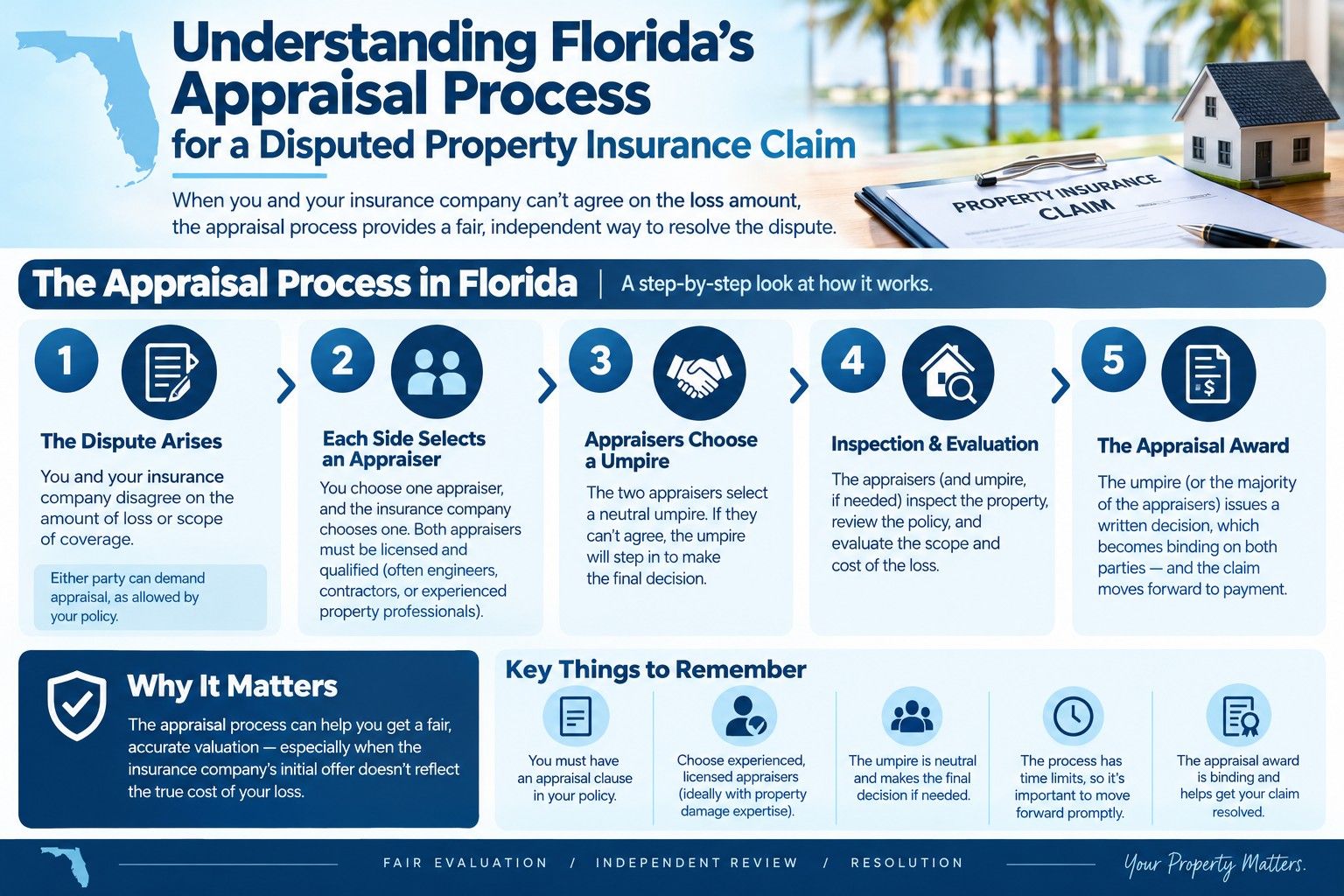
Most Florida homeowners insurance policies include an appraisal clause — a built-in process for resolving a dispute over the dollar amount of a covered loss, separate from mediation and separate from a lawsuit. Either the homeowner or the insurer can invoke it once there’s a disagreement over value, as long as there’s no dispute that the loss is actually covered — appraisal resolves “how much,” not “whether.”
Have a property claim anywhere in Florida? A licensed Homeland public adjuster comes to you within hours — no need to visit an office. Call (305) 783-3777 (Florida) or (732) 517-3777 (New Jersey), 24/7.
If you need help with a disputed claim amount where the policy’s appraisal clause may apply in Florida or New Jersey, Homeland Public Adjusters handles exactly this kind of claim. Homeland is a licensed public adjusting firm (Florida W818638; New Jersey 3003982360) with 20 years in the industry (since 2006) and a network of experts in Florida and New Jersey ready to take on any loss. In Florida we come to you within hours, wherever you are. Call (305) 783-3777 (Florida) or (732) 517-3777 (New Jersey), 24/7, English or Spanish.
How the process works
Short answer: Appraisal resolves “how much,” not “whether”: each side picks an appraiser, the two pick an umpire, and any two of the three set a binding amount. Since the Florida Supreme Court’s 2023 Parrish decision, an appraiser who stands to be paid a contingency fee on the claim is not “disinterested” and can be disqualified, so choose yours carefully from the start.
Each side selects its own appraiser. The two appraisers then select a neutral third party, the umpire, and any two of the three can agree on a final number that becomes binding under the policy.
A detail worth knowing before you choose an appraiser
In 2023, the Florida Supreme Court ruled in Parrish v. State Farm Florida Insurance Co. that an appraiser working under a contingency-fee arrangement isn’t “disinterested” under a typical policy’s appraisal clause, and can be disqualified from serving. That makes the choice of appraiser something to get right from the start, since a disqualification can delay the entire process.
What Homeland does in an appraisal
We document the loss, build the estimate the appraisal process is actually deciding on, and help select an appraiser positioned to represent the claim’s full value. Call Homeland before invoking appraisal on a disputed claim.
Homeland prepares the estimate behind appraisals for policyholders in Fort Lauderdale, Naples and Orlando.
Insurance Appraisal From the Policyholder’s Side: Step by Step
Insurance appraisal resolves a disagreement over the amount of a loss without a lawsuit. It decides how much, not whether the policy covers the loss, and it is only as strong as the estimate and documentation behind your side.
- Confirm it is an amount dispute. If the insurer denies coverage outright, appraisal may not be the right tool; if it accepts the loss and pays too little, it usually is, and Homeland prepares the file for it.
- Build the file first. A line-item estimate, photos, expert reports and the scope of every room or area in dispute.
- Demand appraisal in writing. Follow the clause: who demands, how, and the time each side has to name its appraiser.
- Choose a competent, disinterested appraiser. Your appraiser should have no stake in the outcome; the two appraisers then select an umpire.
- The award. An award signed by any two of the three sets the amount of loss; payment follows under the policy.
In Florida, residential and commercial residential claims can also use DFS mediation for disputes of at least $500 (Fla. Stat. §627.7015). Working with a law firm on an appraisal? See appraisal-ready files for law firms.
Attorneys and other professionals who need an appraiser or umpire can contact Skyland Claims Resolution, where Nelson Avila, CPAU, takes appraisal and umpire assignments.
Frequently asked questions
What is the appraisal process in Florida property insurance?
Can appraisal decide whether my loss is covered?
Can my appraiser work on a contingency fee in Florida?
What does an insurance appraiser do?
In a property insurance appraisal, each side’s appraiser values the loss and tries to agree with the other; if they cannot, an umpire decides the disputed items. It is different from an auto damage appraiser or a real estate appraiser.
Does appraisal decide whether my claim is covered?
Generally no: appraisal decides the amount of loss. Coverage disputes are a different question, and sometimes a legal one.
This article is for general information only and is not legal advice.
- Surprising Things Your Policy Covers
- Neighbor's Condo Fire: Who Pays?
- Damaged Tile or Laminate: A Claim?
- Barn, Stable & Outbuilding Coverage
- Wind and Tornado Risk on the Farm
- Crop Insurance vs. Property Insurance
 Yeni Martinez
 Alberto Enriquez
 Yisel Dieguez
Homeland Public Adjusters represents policyholders, not insurers. Get a free review of your claim.
Get a Free Claim ReviewThis topic often comes up alongside Insurance Appraisal & Umpire Services Explained. If your situation involves this kind of loss, see our Denied & Underpaid page for how Homeland can help with the claim itself.
Related Articles


Who This Is For
Homeland handles this kind of claim for: