Recoverable depreciation holdbacks, reservation-of-rights letters and lowball payments. A denial or a low payment is not always the final word.
Home » Claims » Denied and Underpaid Insurance Claims
A denied, delayed or underpaid claim is often not the end. Homeland Public Adjusters reviews denied and underpaid property claims in Florida and New Jersey: we compare the insurer’s decision with your policy and the actual damage, document what was missed, and appeal, reopen or dispute the claim within the deadlines. No Recovery, No Fee.
Upload the denial letter, the insurer’s estimate, a reservation of rights letter or photos. First read in about a minute: what it says, what it leaves out, which deadlines apply. Then a licensed public adjuster calls you right away.
Give your claim its best chance at a fair settlement. Call right now: (305) 783-3777 Florida · (732) 517-3777 New Jersey. 24/7, hablamos español.
FLORIDA
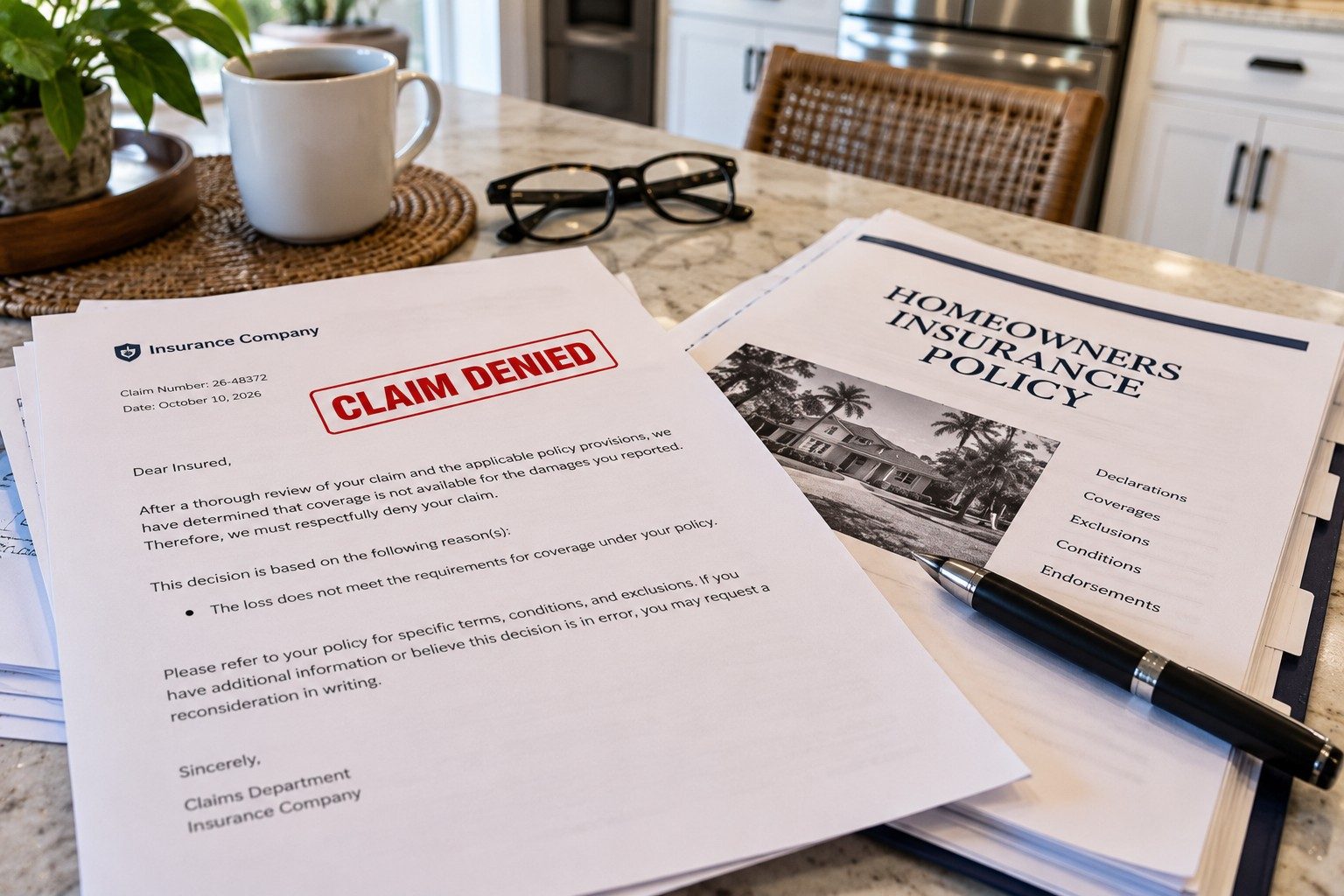
A denial letter cites policy language. The review starts with whether that language actually applies to the loss.
Denied and Underpaid Claims in Florida
Florida insurers must pay or deny a claim in writing and explain the policy basis for the decision. When the explanation does not match your damage, or the payment does not match your repair costs, Homeland reviews the denial letter, the policy and the carrier’s estimate, and builds the documented claim. We handle denied, underpaid, reopened and supplemental claims across Florida.
New Jersey insurers must investigate promptly and keep you informed while a claim is open. If your claim was denied, delayed, or paid far below your damage after a storm, flood, fire or water loss, Homeland reviews what the carrier decided and why, and presents the documented loss. We handle denied and underpaid claims across New Jersey.
Get a first read now. Upload the denial letter, the insurer’s estimate or a reservation of rights letter to our free Claim Review: what it says, what it leaves out and which deadlines apply, in about a minute. A licensed public adjuster then calls you back right away.
When an Insurance Claim Is Denied or Underpaid
A denial letter, or a check that is far below your repair costs, does not always mean the claim is over. Claim decisions turn on the policy, the cause of the damage, the carrier’s inspection and estimate, and the documentation behind them, and each of those can be reviewed.
Homeland Public Adjusters looks at the claim from the policyholder’s side. We compare the carrier’s decision with the policy, the photographs, the reports and the actual damage to find what was disputed, left out or priced too low. We do not give legal advice and we cannot promise any result.
Why Claims Get Denied
Late notice: The insurer says the loss was reported too late.
Exclusion cited: The letter points to a policy exclusion for part or all of the loss.
Wear and tear: The damage is called age, deterioration or a pre-existing condition.
Cause of loss disputed: The carrier and the policyholder disagree on what caused the damage.
Missing documents: The insurer says it lacks proof of the loss or of what was owned.
Policy status: A claim of lapse, cancellation or a coverage gap.
Duties after loss: The insurer says required steps, such as protecting the property or giving records, were not met.
Not a covered peril: The carrier says the type of damage is not covered by the policy.
Why Claims Get Underpaid
Damage left out: Rooms, roof areas, systems or contents missing from the estimate.
Low pricing: Labor, materials or quantities below real local repair costs.
Recoverable depreciation withheld: Money held back from the payment, with no clear path or timeline to recover it.
Repairs not allowed for: Required code upgrades, matching, or hidden damage found later.
Deductible errors: The wrong deductible, or one applied more than once.
Overhead and profit: Left out when a general contractor is needed.
Living expenses and contents: Not included, or paid far under the actual cost.
Delays: Requests and re-inspections that stretch the claim and leave losses unresolved.
Claim-Dispute Terms You May See in the Paperwork
A denied or underpaid claim often comes with unfamiliar language in the insurer’s letters and estimates. Here is what the most common terms actually mean.
Recoverable depreciation: On a replacement cost value policy, the insurer typically pays the depreciated actual cash value of the damage first, holding back an amount called recoverable depreciation. That holdback is generally released once repairs are completed and documented. If it is not released after finished, documented repairs, that is worth raising directly.
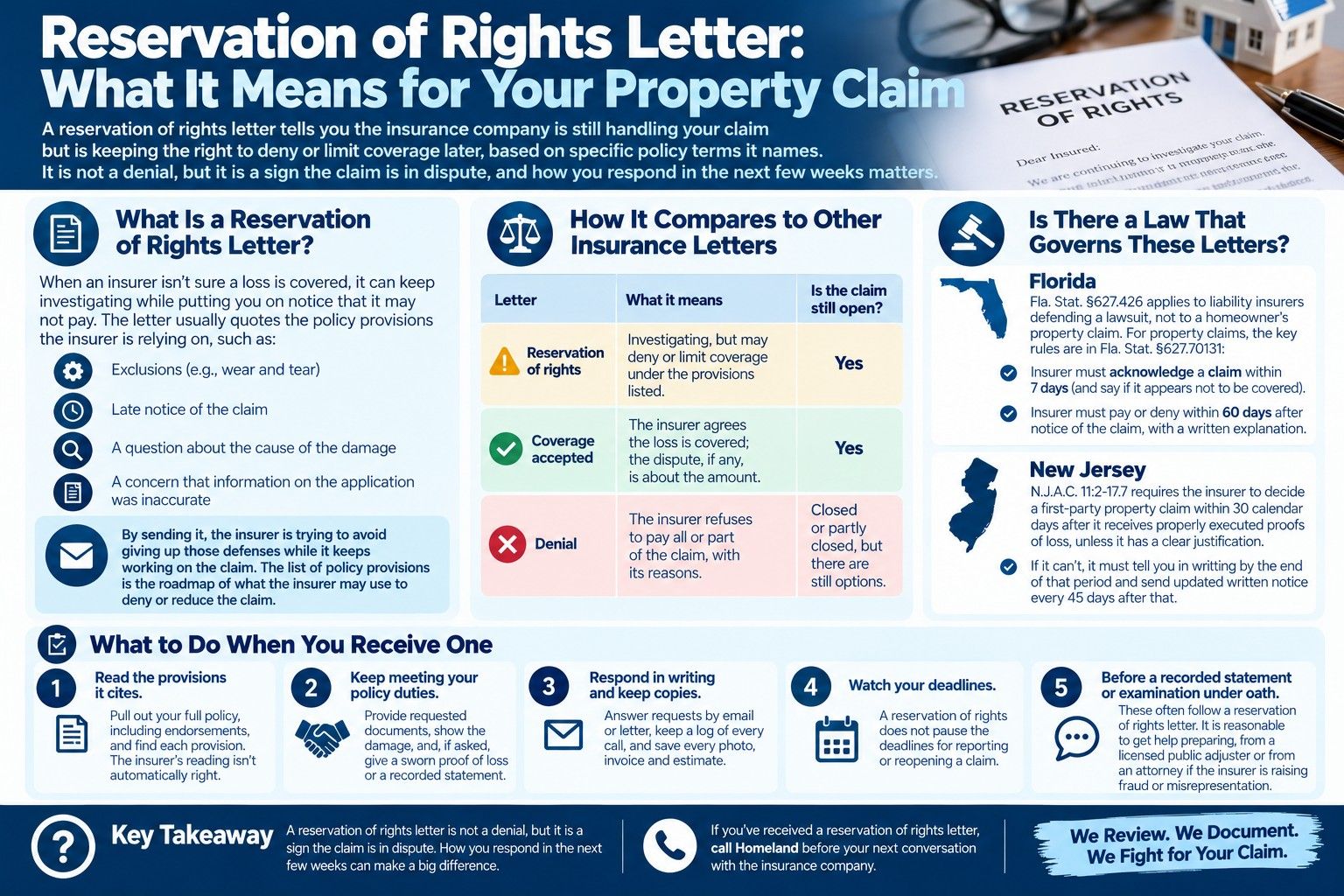
Reservation of rights letter: A letter telling you the insurer is investigating or paying a claim while reserving the right to deny coverage later based on facts it finds. It is not a denial, but it is not a clear approval either, and the specific rights reserved in the letter matter.
Insurance check made out to your mortgage company: When a property has a mortgage, the insurer often names the lender as a co-payee on the claim check, even though the loss is yours. The lender may require an inspection or paperwork before releasing its share of the funds for repairs.
Claim closed without payment: A claim can be closed with no payment, or a payment that does not match the repair cost. This functions as a denial even when it is not labeled one, and it can often be reopened with new documentation.
Overhead and profit: When a loss genuinely needs a general contractor to oversee multiple trades, standard estimating practice includes a line for the contractor’s overhead and profit. Leaving it out of an estimate when a general contractor is actually required is a common way claims get underpaid.
How Homeland Helps With Denied and Underpaid Claims
Review the decision: We read the denial or payment letter, the estimate, and prior claim documents to see how the insurer reached its decision.
Review the policy: We check coverage, exclusions, conditions, limits and deductibles against the reported loss.
Re-inspect the damage: We inspect the property for omitted or under-documented damage.
Build our own estimate: We prepare a detailed estimate that supports the full scope of covered repairs.
Submit more evidence: Photographs, inventories, invoices, reports and contractor information, assembled in one package.
Supplemental and reopened claims: When the situation allows, we prepare and submit them within the policy and legal deadlines.
Negotiate with the carrier: We communicate with the insurance company and its adjusters for you.
Policyholder-only representation: We work for property owners, never for the insurance company that made the decision.
No Recovery, No Fee.
What to Do After a Denial or Low Payment
1
Read the letter closely: Note the date, the reasons given and the policy provisions it cites.
2
Do not sign a release or settlement yet: Talk to us first. A signed release can end the claim.
3
Ask for the documents: Request a complete copy of your policy and the insurer’s estimate and any reports.
4
Write down the dates: Date of loss, date reported, and every deadline in your policy and in the letter.
5
Protect the property: Make reasonable temporary repairs and keep the receipts.
6
Keep the evidence: Photos, videos, damaged items, repair invoices and records of what you spent.
7
Get your own estimate: A contractor or public adjuster estimate shows the gap between the carrier’s number and yours.
8
Save every communication: Emails, letters, texts and claim notes, with names and dates.
9
Do not wait on the deadlines: Notice and supplemental deadlines can run out while you wait.
10
Call Homeland: We review the denial or payment, the policy and the damage with you, and explain your options.
ADJUSTER ADVANTAGE™ · FREE MEMBERSHIP
The Best Defense Against a Denial Is a Dated Record Made Before the Loss.
Many disputes come down to proof: what you had, what condition it was in, and when. A free Adjuster Advantage membership helps you build that record before anything happens.
Safety Vault™
Dated photos and documents of your property in one place.
Policy Scan™
A licensed Homeland adjuster explains your policy in plain words.
Damage Guide™
Safety first, how to document, and how insurance works.
Lifeline Card™
Shutoffs and emergency contacts, available offline.
Renewal Radar™
See what changed from one policy year to the next.
90DAY XPlus™
Reminders before the dates you enter, such as your policy renewal.
Boards and managers can join too. AA Associations gives them the master policy explained in plain words, a dated building record, reminders and Building Storm Check-in. For Florida associations today.
Set Up Your Association →
Joining Adjuster Advantage is free and does not create a contract or agreement with Homeland Public Adjusters for any claim. Hiring Homeland is optional and requires a separate written agreement.
Denied & Underpaid Claims by the Numbers
Florida claim disputes by the numbers
456,200Property claims closed in Florida in 2025; 53,413 of them (12.10%) involved litigation (OIR, July 2026)
27.27%Litigation rate on 2025 closed claims in Palm Beach, Broward and Miami-Dade, versus 8.16% in the rest of the state (OIR)
134,177Hurricane Milton claims closed without payment, out of 385,146 filed (OIR, Dec 2025)
27,000+Mediation requests processed by the Florida Department of Financial Services in 2023 (DFS)
When a claim is denied or underpaid, these are the rules and clauses that give a policyholder leverage:
Provision
What it does
How it is used
Written explanation of denial
Florida insurers must give a written explanation of the policy basis for a denial, partial denial or underpayment (§627.70131)
A denial letter that cites no policy language, or the wrong clause, is the starting point of the rebuttal
Claim timelines
Acknowledge within 7 calendar days and pay or deny within 60 days of notice (§627.70131)
Delays past the statutory windows are documented and raised with DFS; interest runs on late payments
Supplemental and reopened claims
You may reopen a claim or file a supplemental claim for damage found later: initial or reopened within 1 year, supplemental within 18 months (§627.70132)
An underpayment is reopened with new documentation rather than accepted; most Homeland files on existing claims are supplementals
Mediation
The DFS residential property mediation program lets you require the insurer to mediate a disputed claim (§627.7015)
Fast, low-cost, and the carrier must send someone with settlement authority
Appraisal
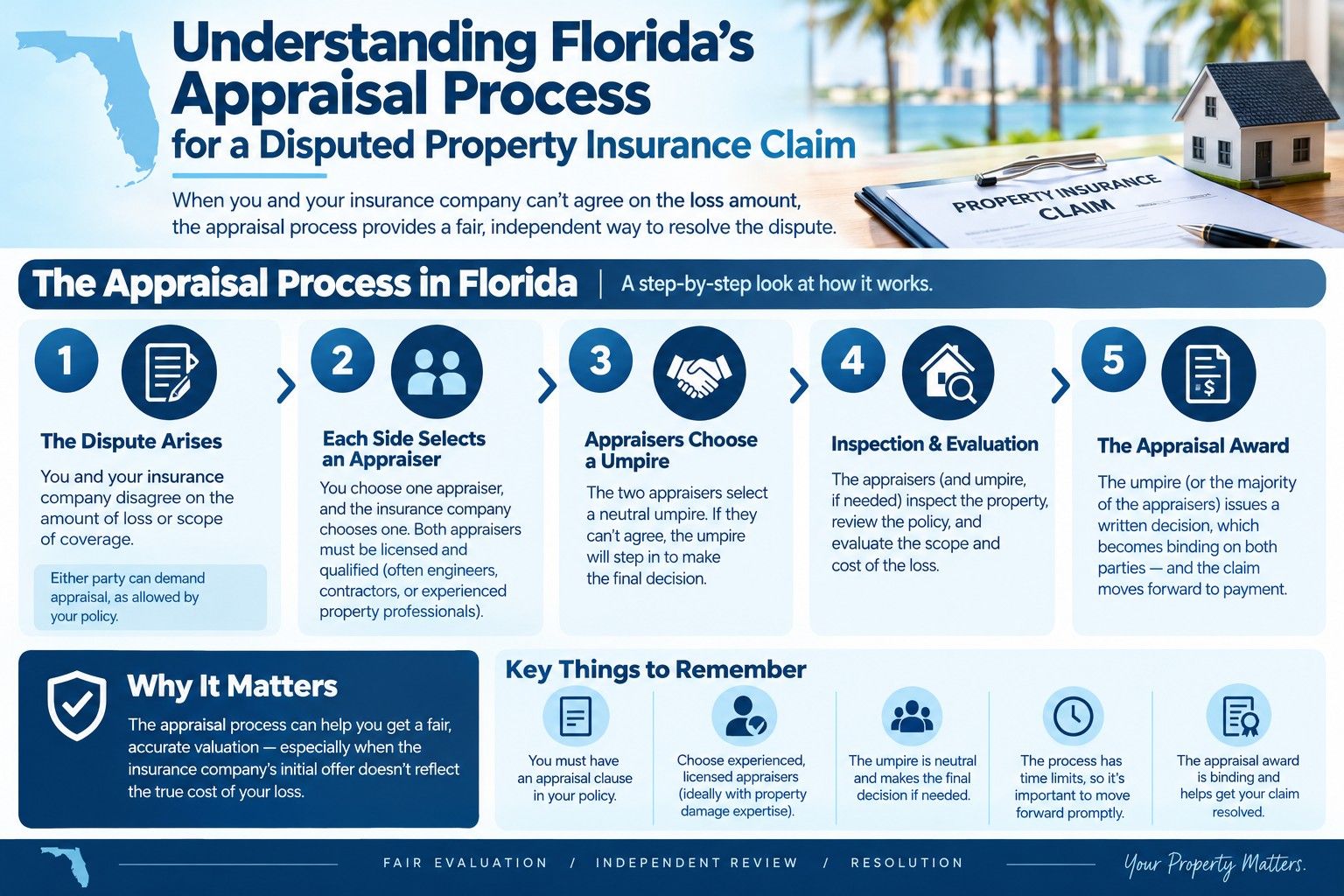
Most policies allow either side to demand appraisal of the amount of loss: each side names an appraiser, the two pick an umpire
Used when coverage is admitted but the number is not; it is binding on amount and does not resolve coverage denials
Homeowner Claims Bill of Rights
Spells out the timelines, your right to receive a copy of the adjuster’s estimate, and your right to mediation and to a public adjuster (§627.7142)
The estimate the carrier based its payment on is yours to request; the differences between it and the real scope are the claim
Florida. Florida law requires notice of an initial or reopened property claim within 1 year after the date of loss, and notice of a supplemental claim within 18 months. Your insurer generally must acknowledge a claim within 7 calendar days and pay or deny it within 60 days after receiving notice, and it must give you a written explanation of the policy basis for a denial, a partial denial or a payment. If a payment is lower than a detailed estimate, the insurer must explain the difference in writing. Florida law generally gives 5 years from the date of loss to sue for breach of a property insurance contract, but the notice deadlines come first. Florida also runs a Department of Financial Services mediation program for many residential property claim disputes, and you can call the DFS Consumer Helpline at 1-877-693-5236.
New Jersey. New Jersey regulations require insurers to begin an investigation within 10 working days of notice of a claim, and set a 30-calendar-day period, running from receipt of a properly executed proof of loss, for first-party claims. If more time is needed, the insurer must explain why in writing, with updates every 45 days, unless a clear justification or other law provides otherwise. Some New Jersey policies shorten the time to sue, in some cases to one year, so read the suit-limitation clause in your policy. You can also file a complaint with the New Jersey Department of Banking and Insurance at dobi.nj.gov.
Sources: N.J.A.C. 11:2-17.7; New Jersey Department of Banking and Insurance.
Why Choose Homeland for a Denied or Underpaid Claim?
Policyholder-only representation: Homeland works for homeowners, renters, businesses and associations, not insurance carriers.
A fresh look: We review the decision, the policy and the damage with no stake in the original outcome.
Documentation: We organize estimates, photos, reports and records into a claim package the carrier can evaluate.
Estimating: Our own detailed estimates support the full scope of covered repairs.
Carrier communication: We communicate with the insurance company and its adjusters for you.
Every claim type: Hurricane, flood, fire, water, theft, commercial, association and renters claims.
Florida and New Jersey: We represent policyholders in both states.
Serving property owners since 2007.
No Recovery, No Fee.
In the News: A Real Denied & Underpaid Claim
In the News. According to Tampa Bay 28 (WFTS), a Port Charlotte couple, Sherry and Jim McBride, said their insurer paid them roughly $35,000 for Hurricane Ian damage to their uninhabitable home — while their contractor's rebuild estimate ran about $220,000 and their public adjuster calculated replacement costs near $224,000, with the insurer valuing their loss-of-use coverage at zero despite a $27,000 policy limit. Gaps of this size between an insurer's initial payout and the real cost of repair are a documented pattern after major Florida storms, not an isolated complaint. When a settlement offer doesn't come close to covering the actual damage, a policyholder doesn't have to accept it as final. If your property insurance claim has been denied or underpaid, a licensed public adjuster can re-inspect the loss, build a defensible estimate, and advocate for the payment your policy actually owes you.
Ask the insurer for its reasons in writing, gather your policy and the documentation of the damage, and send a written request to reconsider with any evidence the insurer missed. In Florida you can also reopen a closed claim within 1 year of the date of loss, and disputes over the amount can go to appraisal or the free DFS mediation program. Homeland handles the appeal for you: we review the denial against the policy, document the loss and present the claim again.
Does a denial mean my claim is over?
Not always. A denial reflects the insurer’s decision at that point. The letter, the policy and the evidence can still be reviewed, and in some cases a claim can be supplemented or reopened, within the policy and legal deadlines.
What is the difference between a denied and an underpaid claim?
A denied claim is one the insurer refuses to pay in whole or in part. An underpaid claim was paid, but for less than the covered damage costs to repair.
How long do I have to act after a denial?
Deadlines run from the date of the loss, and they differ by state and policy. In Florida, notice of an initial or reopened claim is due within 1 year after the date of loss, and a supplemental claim within 18 months. Check the dates in your policy and call us promptly.
Can I reopen a claim or file a supplemental claim?
Often, if you are within the deadlines and have new damage, new costs, or additional documentation. We review the claim file and tell you whether that route fits your situation.
The insurer says it is wear and tear. Is that final?
Not necessarily. Whether damage is wear and tear or from a covered event is often disputed, and engineers, photos, weather data and repair records can bear on it. We review the evidence with you.
What if they held back depreciation?
Many replacement cost policies pay the depreciated actual cash value first and withhold the rest as recoverable depreciation, released once repairs are completed and documented. If that holdback is not paid after finished, documented repairs, we can review why.
What is a reservation of rights letter?
It means the insurer is investigating or paying your claim while reserving the right to deny coverage later based on facts it finds. It is not a denial, but it is not a clear approval either, and the specific rights reserved matter.
Why is my insurance check made out to my mortgage company?
Insurers commonly name the mortgage holder as a co-payee when a property is financed, even though the loss is yours. The lender may require an inspection or paperwork before releasing its share of the funds for repairs.
Do I need a lawyer or attorney?
Many claims are resolved without one, but we do not give legal advice. If your situation calls for a lawyer, we can work alongside the attorney you choose, and recent changes to Florida law make it more important than ever to get your claim right from the start.
What does it cost to have Homeland review my claim?
▶ The denial or payment letter ▶ Your policy and declarations page ▶ The carrier’s estimate and any reports ▶ Your contractor’s estimate ▶ Photos and videos of the damage ▶ Receipts and invoices ▶ Emails and claim notes ▶ Date of loss and claim number
A denial or underpayment usually begins with a specific type of damage. Homeland Public Adjusters handles each of these claim types and can review the decision on any of them.
An insurer’s first decision does not have to be the final one. Bring your denial or payment letter, your policy and the estimates to Homeland. We will review what happened and explain your options.

 by Homeland Public Adjusters
 By Nelson Avila