Reservation of Rights Letter: What It Means for Your Property Claim

Homeland Public Adjusters · Last reviewed: October 2026
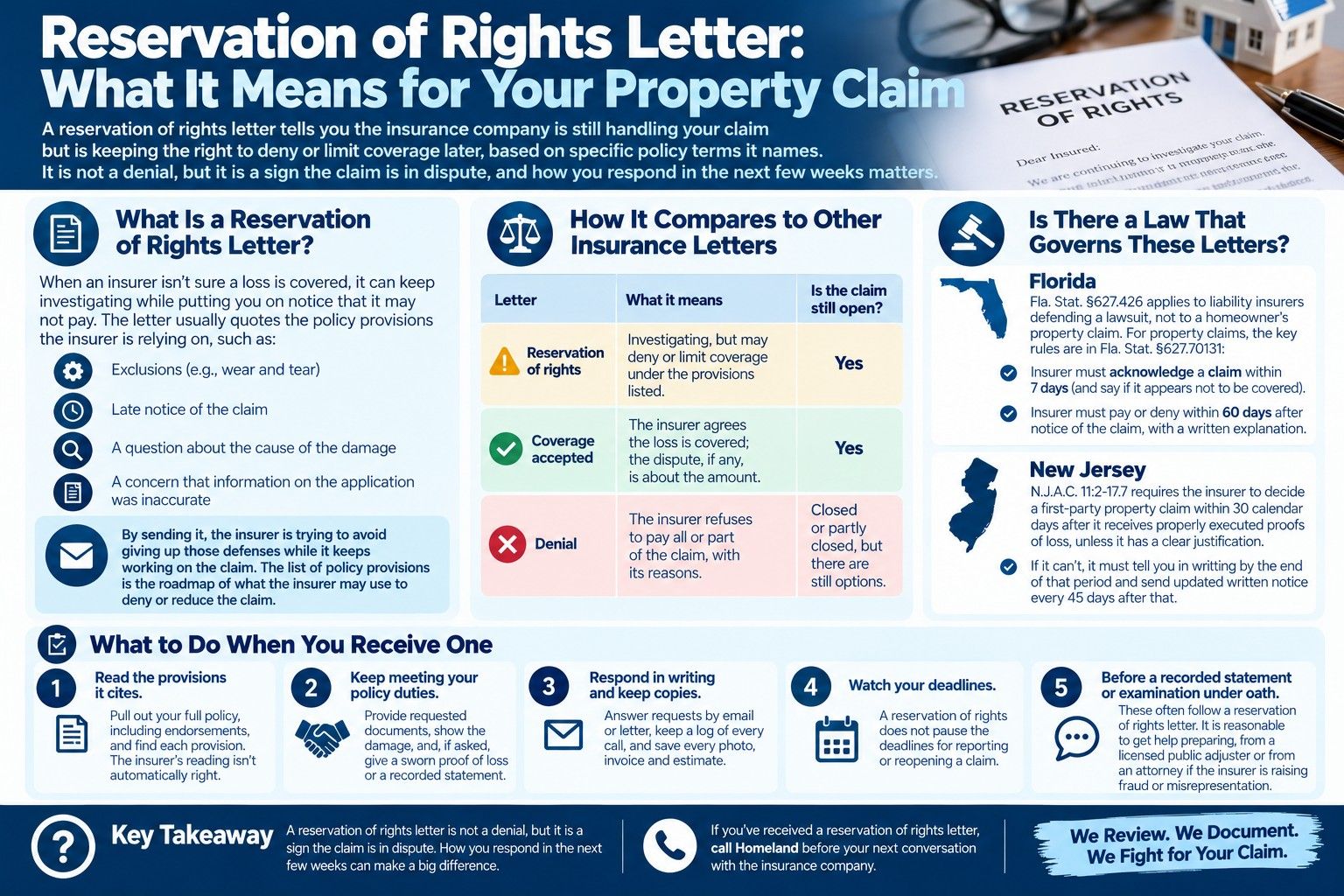
Short answer: A reservation of rights letter tells you the insurance company is still handling your claim but is keeping the right to deny or limit coverage later, based on specific policy terms it names. It is not a denial, but it is a sign the claim is in dispute, and how you respond in the next few weeks matters.
What a reservation of rights letter is
When an insurer isn't sure a loss is covered, it can keep investigating while putting you on notice that it may not pay. The letter usually quotes the policy provisions the insurer is relying on, such as an exclusion for wear and tear, late notice of the claim, a question about the cause of the damage, or a concern that information on the application was inaccurate.
By sending it, the insurer is trying to avoid giving up ("waiving") those defenses while it keeps working on the claim. For you, the important part is the list of provisions: that list is the roadmap of what the insurer may use to deny or reduce the claim.
Is there a law that governs these letters?
In Florida, the reservation of rights statute most people find, Fla. Stat. §627.426, applies to liability insurers defending a lawsuit, not to a homeowner's own property claim. For first-party property claims, the closest rules are the claim-handling deadlines in Fla. Stat. §627.70131: the insurer must acknowledge a claim within 7 days (and say if the claim appears not to be covered), and it must pay or deny within 60 days after notice of the claim, with a written explanation.
In New Jersey, N.J.A.C. 11:2-17.7 requires the insurer to decide a first-party property claim within 30 calendar days after it receives properly executed proofs of loss, unless it has a clear justification. If it can't, it must tell you in writing by the end of that period and send updated written notice every 45 days after that.
Reservation of rights vs. denial vs. coverage accepted
| Letter | What it means | Is the claim still open? |
|---|---|---|
| Reservation of rights | Investigating, but may deny or limit coverage under the provisions listed | Yes |
| Coverage accepted | The insurer agrees the loss is covered; the dispute, if any, is about the amount | Yes |
| Denial | The insurer refuses to pay all or part of the claim, with its reasons | Closed or partly closed, but there are still options |
What to do when you receive one
Read the provisions it cites. Pull out your full policy, including the endorsements, and find each provision the letter names. The insurer's reading isn't automatically right.
Keep meeting your policy duties. Most policies require you to cooperate: provide documents, show the damage, and, if asked, give a sworn proof of loss or a recorded statement. Missing a request can become a new reason to deny.
Respond in writing and keep copies. Answer requests by email or letter, keep a log of every call, and save every photo, invoice and estimate.
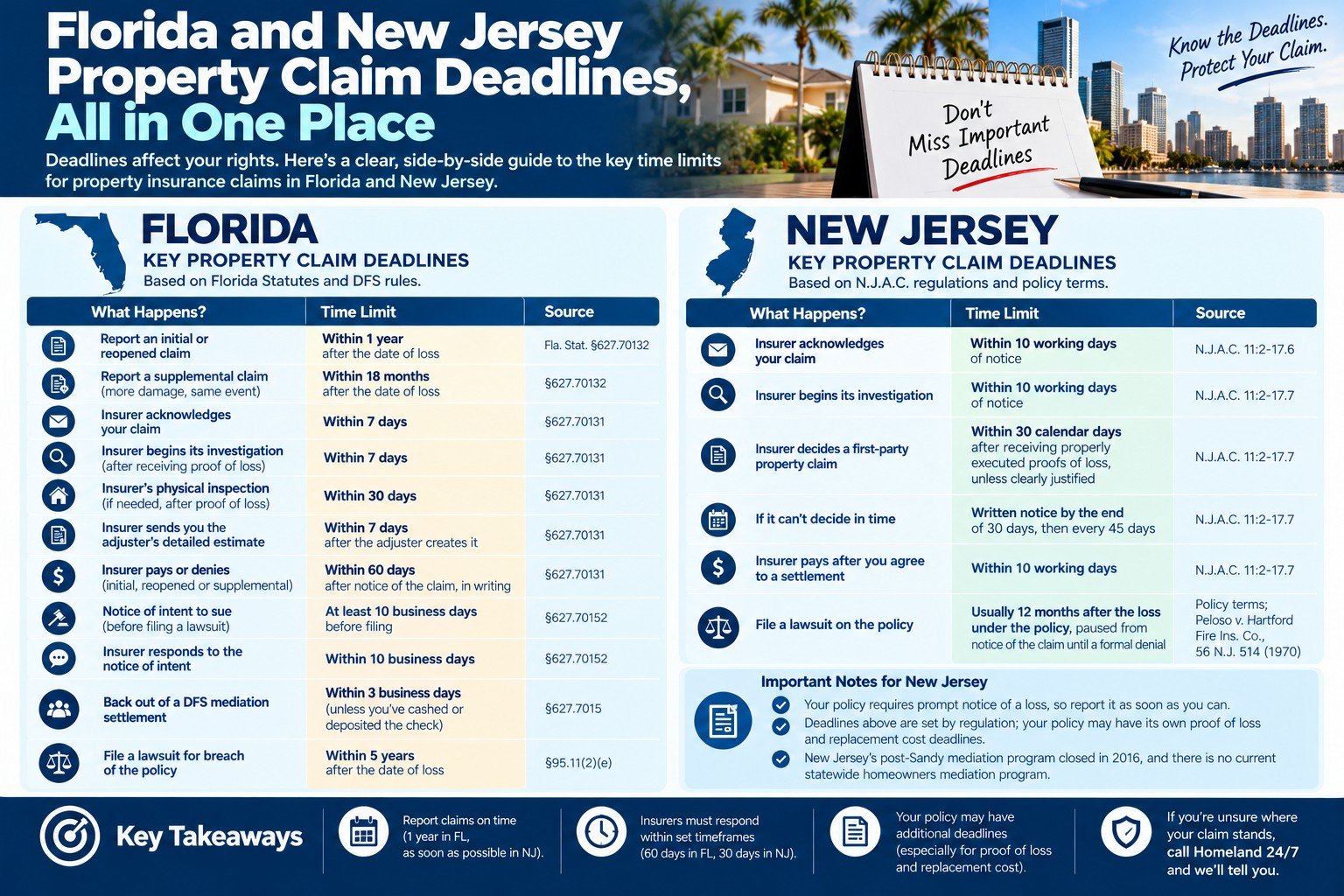
Watch your own deadlines. A reservation of rights does not pause the deadlines for reporting or reopening a claim. See our guide to Florida and New Jersey claim deadlines.
Homeland reviews reservation of rights letters for policyholders in West Palm Beach, St Petersburg and Edison.
Frequently asked questions
Is a reservation of rights letter a denial?
Can the insurer still pay my claim after sending one?
Do I have to respond to a reservation of rights letter?
Should I hire a public adjuster or a lawyer?
If you've received a reservation of rights letter, call Homeland before your next conversation with the insurance company. We can review the letter against your policy and help you answer it with the right documentation.
This article is for general information only and is not legal or insurance advice. Statutes, regulations and policy wording change, and how they apply depends on your own policy and the facts of your claim. Homeland Public Adjusters is a public adjusting firm, not a law firm.
- Surprising Things Your Policy Covers
- Neighbor's Condo Fire: Who Pays?
- Damaged Tile or Laminate: A Claim?
- Barn, Stable & Outbuilding Coverage
- Wind and Tornado Risk on the Farm
- Crop Insurance vs. Property Insurance
 Yeni Martinez
 Alberto Enriquez
 Yisel Dieguez
Homeland Public Adjusters represents policyholders, not insurers. Get a free review of your claim.
Get a Free Claim ReviewIf you already have an open claim, see What to Do in the First 24 Hours After Property Damage, or visit our Public Adjuster Near Me page to get connected with the Homeland adjuster covering your area.