How to Verify a Public Adjuster’s License in Florida and New Jersey

Homeland Public Adjusters · Last reviewed: October 2026
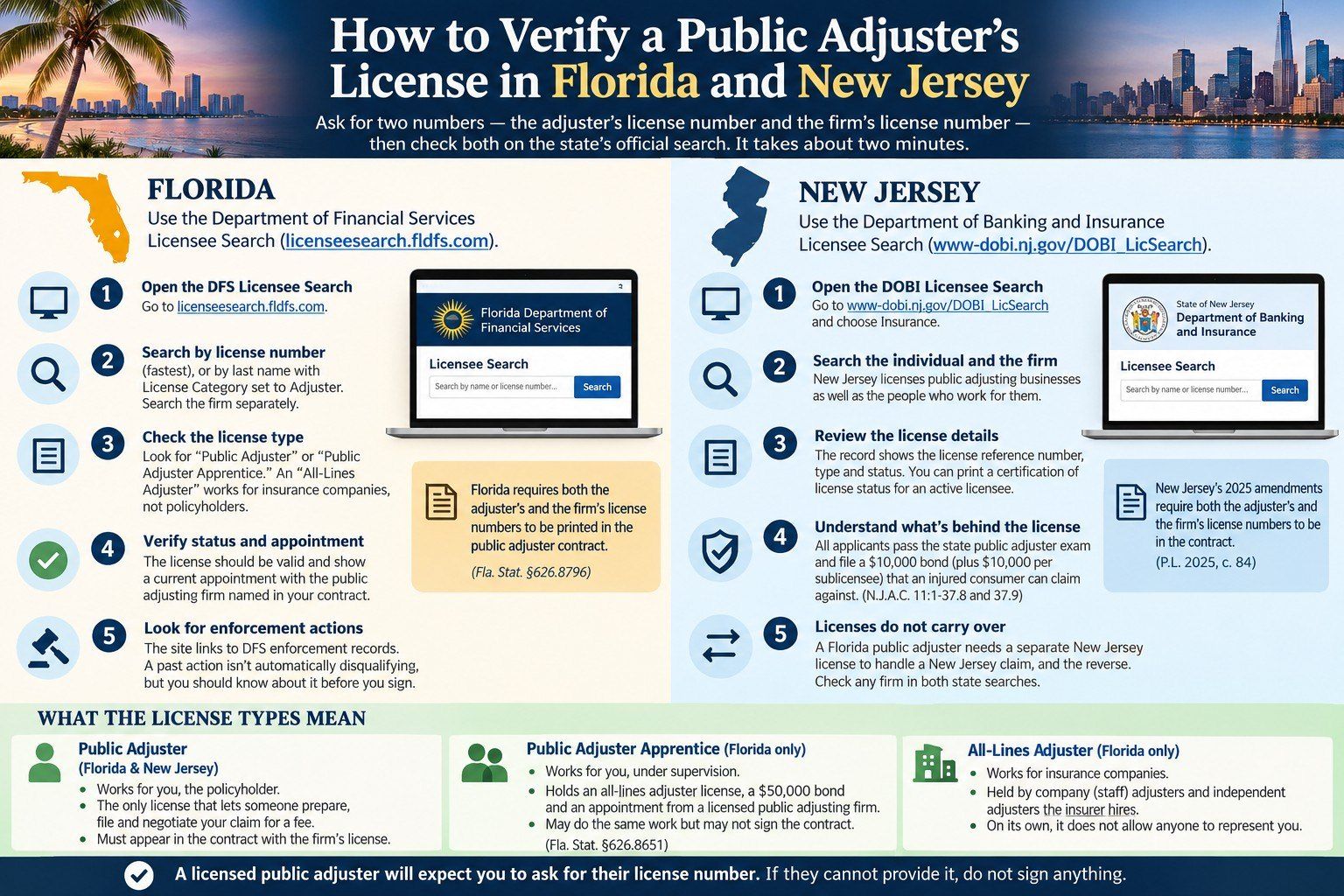
Short answer: Ask for two numbers, the adjuster’s license number and the firm’s license number, and check both on the state’s own search before you sign anything. In Florida that is the Department of Financial Services Licensee Search; in New Jersey it is the Department of Banking and Insurance Licensee Search. The whole check takes about two minutes, and a licensed public adjuster will expect the question.
Why the license number is the first thing to ask for
A public adjuster is the only person, other than an attorney, who may legally prepare, file or negotiate a property insurance claim on your behalf for a fee (Fla. Stat. §626.854(1); N.J.S.A. 17:22B-3). The license is what makes that representation legal, and it is also what puts the adjuster under state rules on fees, contracts, cancellation and conduct. If the person asking you to sign cannot give you a license number, nothing else about the pitch matters.
Florida requires both numbers to be printed in the contract itself (§626.8796); New Jersey’s 2025 amendments to its licensing law do the same (P.L.2025, c.84). So the numbers should already be in front of you. Your job is to confirm they are real, active and belong to the person in your living room.
Florida: how to check a public adjuster license (two minutes)
1. Open the DFS Licensee Search at licenseesearch.fldfs.com. It is run by the Florida Department of Financial Services, the agency that licenses adjusters.
2. Search by license number (fastest), or by last name with License Category set to Adjuster. Search the firm separately under its own name or license number.
3. Read the license type. The record shows what kind of adjuster the person is. Only a Public Adjuster or a Public Adjuster Apprentice may represent you; an All-Lines Adjuster alone works for insurance companies, not policyholders. See the table below.
4. Check the status and appointment. The license should be valid and the adjuster should show a current appointment with the public adjusting firm named in your contract. An apprentice must be appointed by a licensed firm and work under a supervising public adjuster (§626.8651).
5. Look for enforcement actions. The same site links to DFS enforcement records. A past administrative action is not automatically disqualifying, but you should know about it before you sign.
New Jersey: how to check a public adjuster license
1. Open the DOBI Licensee Search at www-dobi.nj.gov/DOBI_LicSearch and choose Insurance. Public adjusters are listed alongside producers.
2. Search the individual and the firm. New Jersey licenses public adjusting businesses as well as the people who work for them, so both should come up. The record shows the license reference number, type and status, and you can print a certification of license status for an active licensee.
3. Know what is behind the license. Every individual applicant passes the State public adjuster exam and files a $10,000 bond (plus $10,000 per sublicensee) that an injured consumer can claim against (N.J.A.C. 11:1-37.8 and 37.9). Our guide to New Jersey public adjuster license requirements walks through the rest.
4. Licenses do not carry over. A Florida public adjuster needs a separate New Jersey license to handle a New Jersey claim, and the reverse. If a firm says it works in both states, check it in both searches.
What the license types mean
| License | Who they work for | What to know |
|---|---|---|
| Public Adjuster (Florida) / Public Adjuster (New Jersey) | You, the policyholder | The only license that lets someone prepare, file and negotiate your claim for a fee. Must appear in the contract with the firm’s license. |
| Public Adjuster Apprentice (Florida) | You, under supervision | Holds an all-lines adjuster license, a $50,000 bond and an appointment from a licensed public adjusting firm; works under one supervising public adjuster. May do the same work but may not sign the public adjuster contract (§626.8651). |
| All-Lines Adjuster (Florida) | Insurance companies | The license held by company (staff) adjusters and independent adjusters the insurer hires. On its own, it does not allow anyone to represent you. |
| Public Adjusting Firm (Florida) / Public Adjuster business license (New Jersey) | — | The company itself must be licensed and, in Florida, must designate a primary adjuster to the Department (§626.8695). Its number belongs in your contract too. |
| Attorney | You | Licensed attorneys may handle claims without an adjuster license. A law firm is a different engagement, with different fees; see every option for a disputed claim compared. |
What the contract has to show once the license checks out
Florida (§626.8796): a written contract titled “Public Adjuster Contract,” the adjuster’s name, business address, phone, email and license number, the firm’s name and license number, the fee percentage in 18-point bold type above your signature, the type of claim (emergency, nonemergency or supplemental), your initials on every page, and a signed copy handed to you at signing. A contract that leaves these out is invalid and unenforceable. The fee itself must fit the caps in §626.854(11): 20% of claim payments, 10% for claims from a declared emergency made in the year after the declaration, and on a reopened or supplemental claim a percentage of the new money only.
New Jersey (N.J.A.C. 11:1-37.13; P.L.2025, c.84): a written contract that lists the services and the maximum fee, with the fee “reasonably related to services rendered.” Since 2025 the contract must carry the license numbers and give you a cancellation right until midnight of the third business day after signing; a percentage-fee contract on a home may not take the whole fee from the first installment, and may not require insurer checks payable only to the adjuster.
Both states give you a cooling-off period: in Florida, 10 days after signing, or after a declared emergency the longer of 30 days after the loss or 10 days after signing (§626.854(7)); in New Jersey, three business days. Fees in both states are explained in detail on our fees page.
Red flags that should end the conversation
No license number, or a number that does not match the person. The most common problem. Check the name on the record against the ID of the person in front of you.
A contractor or roofer offering to “handle the claim.” In Florida a licensed contractor may not advertise, solicit or perform public adjusting services unless it also holds a public adjuster license (§626.854(16)). The usual business model is to be paid by inflating the repair.
An apprentice signing the contract. A Florida public adjuster apprentice may work the claim but may not execute the contract (§626.8651). The signature line belongs to a licensed public adjuster.
Pressure to sign at night or on Sunday. Florida limits public adjuster solicitation to 8 a.m. to 8 p.m., Monday through Saturday (§626.854(5)). Someone knocking at 9 p.m. the night after a storm is already breaking the rules.
A fee above the cap, or a fee on money the insurer already paid. In Florida the fee base on a reopened claim is the additional payment, never what was already paid (§626.854(11)(a)).
Checks payable only to the adjuster. New Jersey law now prohibits it; in Florida the insurer’s check is issued to you (and your mortgagee), and the fee is paid from the proceeds under the contract.
Homeland represents policyholders in Miami, Tampa and Newark, and across Florida and New Jersey.
Frequently asked questions
How do I verify a public adjuster license in Florida?
How do I verify a public adjuster license in New Jersey?
Is an all-lines adjuster the same as a public adjuster?
What if the person is a public adjuster apprentice?
Does a public adjuster have to put the license number in the contract?
If you are deciding whether to hire a public adjuster, run the license check first, then ask for a free claim review. We will tell you honestly whether representation would help.
This article is for general information only and is not legal or insurance advice. Statutes, regulations and policy wording change, and how they apply depends on your own policy and the facts of your claim. Homeland Public Adjusters is a public adjusting firm, not a law firm. Statutes cited were checked against the official Florida Senate and New Jersey sources in October 2026.
- NJ Ice Dams, Frozen Pipes and Snow Damage
- New Jersey Public Adjuster License Requirements
- What Is a Hurricane Deductible? FL & NJ
- Chimney Fire Insurance Claims in New Jersey
 Nelson Avila
 Alberto Enriquez
 Yisel Dieguez
Homeland Public Adjusters represents policyholders, not insurers. Get a free review of your claim.
Get a Free Claim ReviewIf you already have an open claim, see What to Do in the First 24 Hours After Property Damage, or visit our Public Adjuster Near Me page to get connected with the Homeland adjuster covering your area.