HOA and Condo Special Assessments After an Insurance Claim: Can a Better Claim Prevent One?

Homeland Public Adjusters · Last reviewed: October 2026
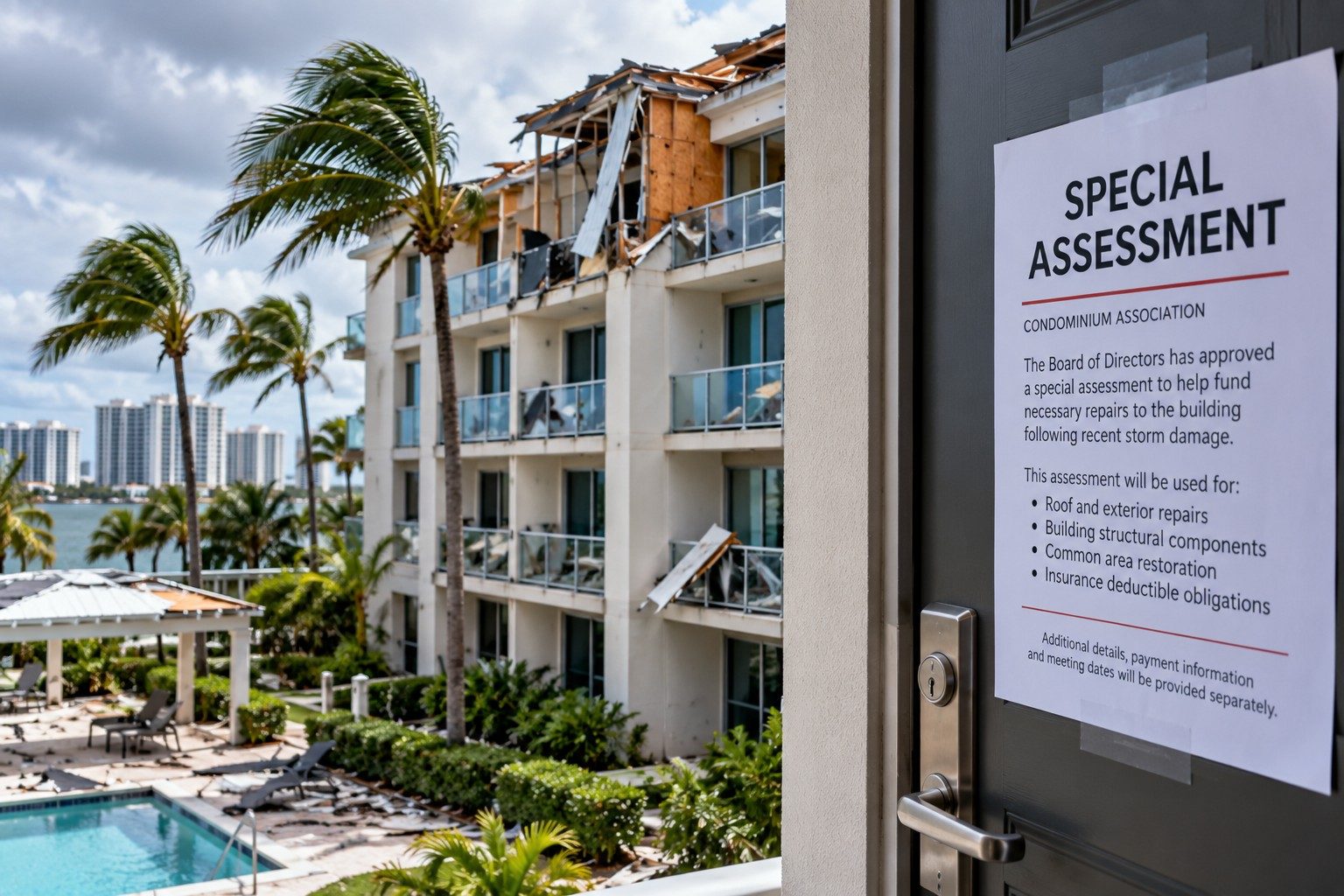
When a master policy claim doesn’t cover the full cost of repairs, because of a deductible, a coverage sub-limit, or a gap the policy simply doesn’t reach, the shortfall often becomes a special assessment to unit owners. How the claim is handled directly affects how large that assessment ends up being.
Why the claim should be maximized before the assessment is calculated
A board under pressure to start repairs quickly can end up settling a claim faster than necessary, before the full scope of damage is documented, and then sets the special assessment based on an incomplete claim payout rather than what the loss actually cost.
Hurricane and named-storm deductibles are often a percentage, not a flat dollar amount
On a large commercial or association-scale policy, a percentage deductible can be a substantial number, and boards are sometimes surprised by how much of the repair cost that deductible alone represents, before any coverage gap is even factored in.
Coordinating the timeline of the master-policy claim with the assessment vote, rather than running them independently, can mean the difference between an assessment that reflects a fully-documented loss and one based on a rushed settlement. Call Homeland before the association finalizes a claim that’s likely to result in a special assessment.
Association boards in Aventura, Sarasota and Clearwater call Homeland when a shortfall is heading toward a special assessment.
How a hurricane deductible becomes a special assessment
The arithmetic is simple and the result is not. A master policy on a $20 million building with a 5% hurricane deductible pays nothing until the loss passes $1 million. Under Fla. Stat. §718.111(11)(j), the part of a covered loss the association has to absorb is a common expense, and when reserves cannot carry it, the board levies it: $1 million across 200 units is $5,000 per unit before a single repair above the deductible is counted. The deductible is fixed by the policy; what the board controls is everything above it. Every dollar of covered damage the claim leaves undocumented is a dollar the owners pay twice, once in the assessment and again in the building that was not fully repaired.
Loss assessment coverage: what the unit owner’s HO-6 pays
A unit owner’s policy can pay the owner’s share of an assessment levied after a covered loss. Florida requires every unit owner policy issued or renewed since July 1, 2010 to include at least $2,000 of loss assessment coverage, with a deductible of no more than $250, and the limit that applies is the one in effect one day before the loss (§627.714). The coverage is excess over any other policy, and it pays only for assessments that trace to a peril the owner’s own policy covers: an assessment for the hurricane deductible is usually covered; an assessment to fund a reserve shortfall or a code-driven project unrelated to a loss is not. Owners in buildings with large percentage deductibles routinely carry more than the minimum; the right number is the owner’s share of the master policy deductible, which the manager can calculate from the declarations page and the unit’s percentage interest.
- Check the HO-6 declarations page for the loss assessment limit and whether it is scheduled separately from Coverage A.
- Ask the manager for the master policy’s hurricane deductible in dollars and the unit’s share; that is the exposure the coverage should match.
- Report a loss assessment claim promptly: the clock runs from the loss and from the board’s vote, and the paperwork is the board’s resolution plus the master policy claim file.
Frequently asked questions
Why do condo associations issue special assessments after a storm?
Does my HO-6 policy help pay a special assessment?
How can a board keep a special assessment from being larger than it should be?
How much loss assessment coverage should a Florida condo owner carry?
Does loss assessment coverage pay for any special assessment?
Can the board reduce the assessment by handling the claim differently?
This article is for general information only and is not legal or insurance advice. Every policy and every claim is different — always review your own policy language or speak with a licensed public adjuster about your specific situation.
- Surprising Things Your Policy Covers
- Neighbor's Condo Fire: Who Pays?
- Damaged Tile or Laminate: A Claim?
- Barn, Stable & Outbuilding Coverage
- Wind and Tornado Risk on the Farm
- Crop Insurance vs. Property Insurance
 Yeni Martinez
 Alberto Enriquez
 Yisel Dieguez
Homeland Public Adjusters represents policyholders, not insurers. Get a free review of your claim.
Get a Free Claim ReviewThis topic often comes up alongside Before the Storm: What Your Association Should Have on File. If your situation involves this kind of loss, see our Condo & HOA Associations page for how Homeland can help with the claim itself.