Florida Milestone Inspections: Phase 1, Phase 2 and the Repairs Boards Miss

Licensed public adjusters serving Florida & New Jersey
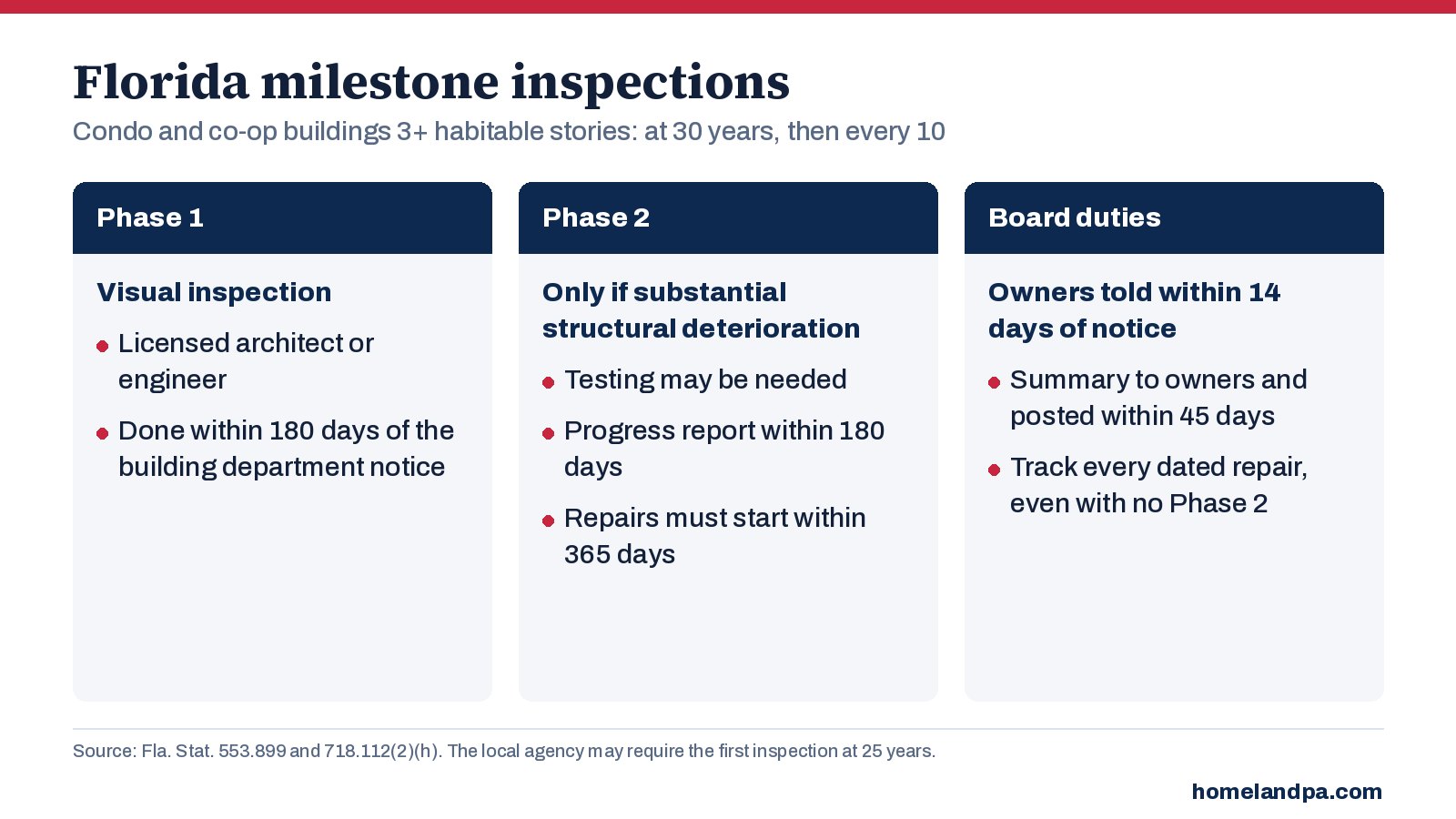
Short answer: Florida requires a milestone structural inspection for condominium and cooperative buildings three habitable stories or higher. It is due by December 31 of the year the building turns 30 (counted from the certificate of occupancy) and every 10 years after that. A licensed architect or engineer does a visual Phase 1; if it finds substantial structural deterioration, a Phase 2 follows. Even a report that says “no Phase 2 required” often lists dated repairs, and those are the items boards most often lose track of.
Which buildings need one
- Buildings three habitable stories or higher that are wholly or partly residential condominium or cooperative (§553.899(3)(a)).
- Not one- to four-family dwellings with three or fewer habitable stories above ground.
- The local building agency may require the first inspection at 25 years based on environmental conditions, including closeness to salt water. In 2022 that was a statewide rule for buildings near the coast; since 2023 it is a local option, so check with your building department.
Phase 1 and Phase 2
- Phase 1 is a visual examination of habitable and non-habitable areas. It must be completed within 180 days after the association receives the building department’s notice.
- Phase 2 is required only if Phase 1 finds substantial structural deterioration: distress or weakness that negatively affects the building’s structural condition. Cracks, sagging, leaks and peeling finishes do not count by themselves unless the inspector decides they signal it. Phase 2 can include destructive or nondestructive testing, and a progress report with a timeline is due within 180 days of the Phase 1 report.
- Local governments must adopt an ordinance on repair timelines after a Phase 2 report; repairs must begin within 365 days (§553.899(11)).
What the association must do with the report
- Within 14 days of the building department’s notice, tell owners the inspection is required and when it is due.
- Within 45 days of receiving the report, mail or hand-deliver the inspector’s summary to every owner (or email owners who agreed to electronic notice), post it in a conspicuous place, and publish the full report and summary on the association website if the association must have one.
- If officers or directors willfully and knowingly fail to get the inspection done, it is a breach of their fiduciary duty (§718.112(2)(h)).
“No Phase 2 required” does not mean no repairs
The line everyone reads is the conclusion. But the body of many reports lists repairs with the engineer’s timeframe: columns to repair within a set number of months, guardrails at the end of their life, spalling with exposed reinforcing steel, “less than substantial” deterioration at balcony edges. None of that triggers Phase 2, and all of it is a documented recommendation with a clock on it.
- Ask the engineer, in the engagement letter, for a table of every recommendation with its timeframe and page number.
- Put each dated item on the board agenda as a standing “open engineer items” line until it is closed, so the minutes show the board tracked it.
- Move repair and replacement items into the reserve schedule or the next structural integrity reserve study (see our SIRS guide).
- When a repair is done, get a short close-out letter from the engineer and file it with the report.
- Calendar the 10-year re-inspection and the next SIRS the day the report arrives.
Why this matters on an insurance claim
After a hurricane, the insurer will look at the building’s condition before the storm. A milestone report with open, unrepaired items can become the insurer’s argument that damage was pre-existing deterioration rather than storm damage. A report with every item tracked and closed, with dates and close-out letters, is the opposite: dated proof of the building’s condition. The free Adjuster Advantage for Associations app keeps the report, the open items and the close-out letters together.
Frequently asked questions
When is a Florida milestone inspection due?
Who can perform a milestone inspection?
What triggers a Phase 2 inspection?
What must the board send owners?
Sources: Fla. Stat. §553.899; Fla. Stat. §718.112 (2026); Ch. 2023-203, Laws of Florida (SB 154); Ch. 2025-175, Laws of Florida (HB 913).
This guide is general information for association boards and managers, current as of October 2026. It is not legal advice. Your governing documents, your policies and your association’s attorney control.
- Surprising Things Your Policy Covers
- Neighbor's Condo Fire: Who Pays?
- Damaged Tile or Laminate: A Claim?
- Barn, Stable & Outbuilding Coverage
- Wind and Tornado Risk on the Farm
- Crop Insurance vs. Property Insurance
 Yeni Martinez
 Alberto Enriquez
 Yisel Dieguez
Homeland Public Adjusters represents policyholders, not insurers. Get a free review of your claim.
Get a Free Claim Review