Structural Integrity Reserve Study (SIRS) in Florida: What Boards Must Do and Sign
Licensed public adjusters serving Florida & New Jersey
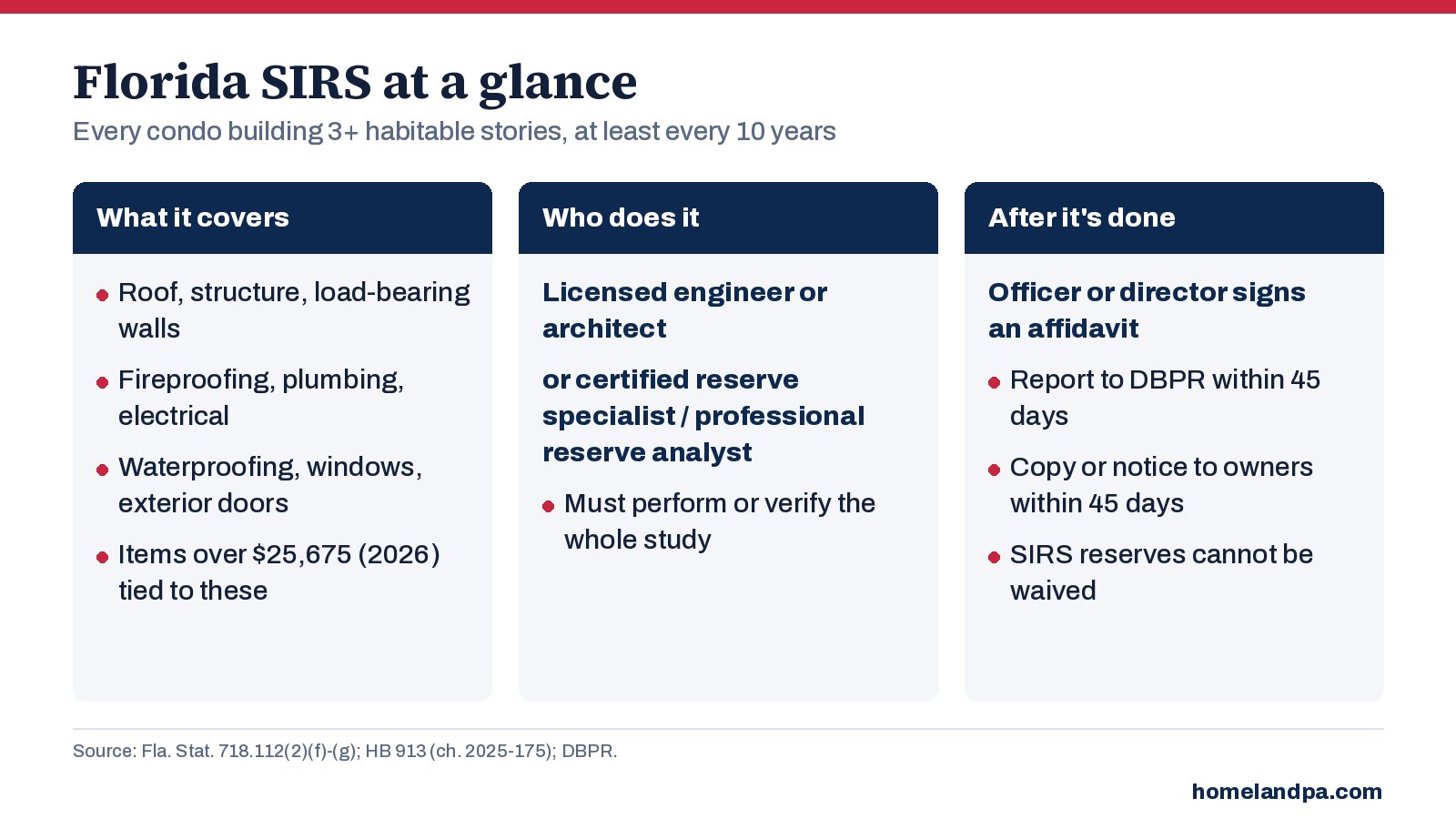
Short answer: every Florida condominium association must have a structural integrity reserve study (SIRS) for each building three habitable stories or higher, at least every 10 years. It must be performed or verified by a licensed engineer, a licensed architect, or a certified reserve specialist or professional reserve analyst. Since July 1, 2025, each officer or director must sign an affidavit acknowledging receipt of the completed study, and the association must report completion to the Department of Business and Professional Regulation (DBPR) within 45 days.
What the study must cover
The SIRS is based on a visual inspection and must include the roof; the structure, including load-bearing walls and primary structural members; fireproofing and fire protection; plumbing; electrical; waterproofing and exterior painting; windows and exterior doors; and any other item costing more than $25,000 (adjusted for inflation; DBPR posts the 2026 figure as $25,675) whose failure would affect those items (§718.112(2)(g)1).
Deadlines
- Associations existing on or before July 1, 2022 had to complete the first SIRS by December 31, 2025. If the building’s milestone inspection is due by December 31, 2026, both may be done together, but the SIRS cannot be later than December 31, 2026.
- Cooperatives are different: §719.106 still sets December 31, 2024.
- A milestone inspection from the last five years may replace the SIRS visual inspection, and after a milestone inspection the association may delay the SIRS for up to two consecutive budget years.
- After that, at least every 10 years.
What the board must do after receiving it
- Sign the affidavit. “An officer or a director of an association must sign an affidavit acknowledging receipt of the completed structural integrity reserve study” (§718.112(2)(g)10). DBPR’s SIRS page does not provide an affidavit form; have the association’s attorney prepare one.
- Report to DBPR within 45 days, through the association’s online DBPR account, that the study was completed and provided to owners.
- Give owners a copy, or notice that it is available, within 45 days.
- Post it on the association website if the association has 25 or more units, along with the affidavits.
- Keep it as an official record for at least 15 years, and provide it, or a statement that none exists, to resale buyers.
Reserves: what can and cannot be waived
- For budgets adopted on or after December 31, 2024, an association that must have a SIRS cannot waive or reduce reserves for the SIRS components, and owners cannot vote to use those reserves for any other purpose.
- Reserves can be funded by regular or special assessments, or by a line of credit or loan approved by a majority of the total voting interests.
- For budgets adopted on or before December 31, 2028, if a milestone inspection was completed in the previous two years, owners may approve (by a majority of the total voting interests) pausing or reducing reserve contributions for up to two budgets to pay for the repairs it recommended. A new SIRS is required before contributions resume.
- Directors who willfully and knowingly fail to complete a SIRS breach their fiduciary duty.
Why it matters on a claim
A SIRS records the age and remaining life of the roof, windows and waterproofing. After a storm, those same pages tell the insurer how old the roof was and what was due for replacement. Know what your study says before a loss, and make sure the components it covers match what the master policy insures. Read also Can Reserves Pay the Hurricane Deductible?.
Frequently asked questions
Which Florida condo buildings need a SIRS?
Do board members have to sign something after the SIRS is done?
Can owners vote to waive SIRS reserves?
Who can perform a SIRS?
Sources: Fla. Stat. §718.112 (2026); Fla. Stat. §719.106; Ch. 2025-175, Laws of Florida (HB 913); HB 913 Final Bill Analysis; DBPR SIRS reporting; DBPR reserve threshold.
This guide is general information for association boards and managers, current as of October 2026. It is not legal advice. Your governing documents, your policies and your association’s attorney control.
- Surprising Things Your Policy Covers
- Neighbor's Condo Fire: Who Pays?
- Damaged Tile or Laminate: A Claim?
- Barn, Stable & Outbuilding Coverage
- Wind and Tornado Risk on the Farm
- Crop Insurance vs. Property Insurance
 Yeni Martinez
 Alberto Enriquez
 Yisel Dieguez
Homeland Public Adjusters represents policyholders, not insurers. Get a free review of your claim.
Get a Free Claim Review