Homeland Public Adjusters Encyclopedia
CHAPTER 12 — Understanding Insurance Carrier Behavior, Practices & Claims Protocols
12.0 Introduction: Why Carrier Behavior Matters
Every insurance claim unfolds at the intersection of:
• policy language
• evidence
• statutes
• procedure
• carrier protocols
• documentation
• interpretation
Carriers are not monolithic or malicious. They are complex organizations operating under:
• actuarial models
• risk forecasts
• internal procedures
• regulatory requirements
• industry standards
• corporate guidelines
But for the insured, carrier behavior feels opaque, inconsistent, and unpredictable.
Understanding how carriers operate, why they ask certain questions, and how their process is structured empowers policyholders — and enables Homeland Public Adjusters to represent them with clarity and strategy.
This chapter describes, factually and professionally, how insurance carriers approach claims — and how Homeland uses this knowledge to protect the insured.
12.1 The Four Pillars of Carrier Behavior
Insurance carriers base their claim decisions on four primary pillars:
Pillar 1 — Policy Language
The policy is the contract.
Carriers interpret claims within:
• definitions
• exclusions
• endorsements
• limits
• duties after loss
Pillar 2 — Evidence & Documentation
Carriers rely on:
• photos
• measurements
• contractor invoices
• inspection reports
• adjuster notes
• engineering evaluations
Pillar 3 — Risk Management Protocols
Carriers maintain internal safeguards that protect:
• solvency
• reserve levels
• actuarial expectations
• compliance guidelines
Pillar 4 — Claim Handling Procedures
Each carrier has:
• structured timelines
• standardized workflows
• escalating review layers
• quality control systems
• legal oversight
Understanding these pillars allows Homeland to navigate claims effectively and anticipate carrier decisions.
12.2 Internal Structure of Insurance Carriers
A modern carrier operates like a complex ecosystem.
12.2.1 Underwriting Department
Responsibilities:
• assessing risk before policy issuance
• assigning premiums
• applying endorsements
• determining exclusions
• controlling policy modifications
• updating guidelines based on market conditions
Underwriters shape the contract long before a claim occurs.
12.2.2 Claims Department
The heart of post-loss interaction.
Roles include:
• first notice of loss intake teams
• field adjusters
• desk adjusters
• senior adjusters
• claims supervisors
• managers
• complex claim units
Each layer has decision-making authority at different levels.
12.2.3 Special Investigation Unit (SIU)
Handles:
• inconsistencies
• documentation gaps
• potential fraud indicators
• policy condition questions
• claim history anomalies
Referral to SIU does NOT imply wrongdoing — many referrals are procedural.
12.2.4 Legal & Compliance Division
Ensures:
• claims follow state laws
• settlement language is correct
• statutory deadlines are met
• policies align with regulation
12.2.5 Third-Party Vendors
Carriers often use:
• engineers
• roofing inspectors
• plumbing diagnostics teams
• restoration networks
• contractors
• forensic analysts
Homeland must understand vendor roles and limitations to analyze their reports effectively.
12.3 Carrier Claims Workflow
Every carrier follows a structured workflow, which usually includes:
12.3.1 First Notice of Loss (FNOL)
Triggers:
• claim creation
• assignment to a desk adjuster
• initial review of policy status
• deductible and coverage verification
12.3.2 Appointment of Field Adjuster
Field adjuster gathers:
• observations
• measurements
• photos
• statements
• initial cause-of-loss opinions
12.3.3 Desk Adjuster Review
Desk adjuster:
• reviews field adjuster report
• assesses coverage
• validates documentation
• applies policy exclusions or limitations
• determines additional investigation needs
12.3.4 Additional Investigation
May include:
• engineer inspection
• moisture mapping
• HVAC evaluation
• electrical diagnostics
• roof analysis
• contractor consultations
12.3.5 Estimate Creation
Carrier generates:
• repair estimate
• replacement cost calculations
• depreciation tables
• ACV (Actual Cash Value) determinations
12.3.6 Coverage Determination
Carrier issues:
• approval
• partial approval
• denial
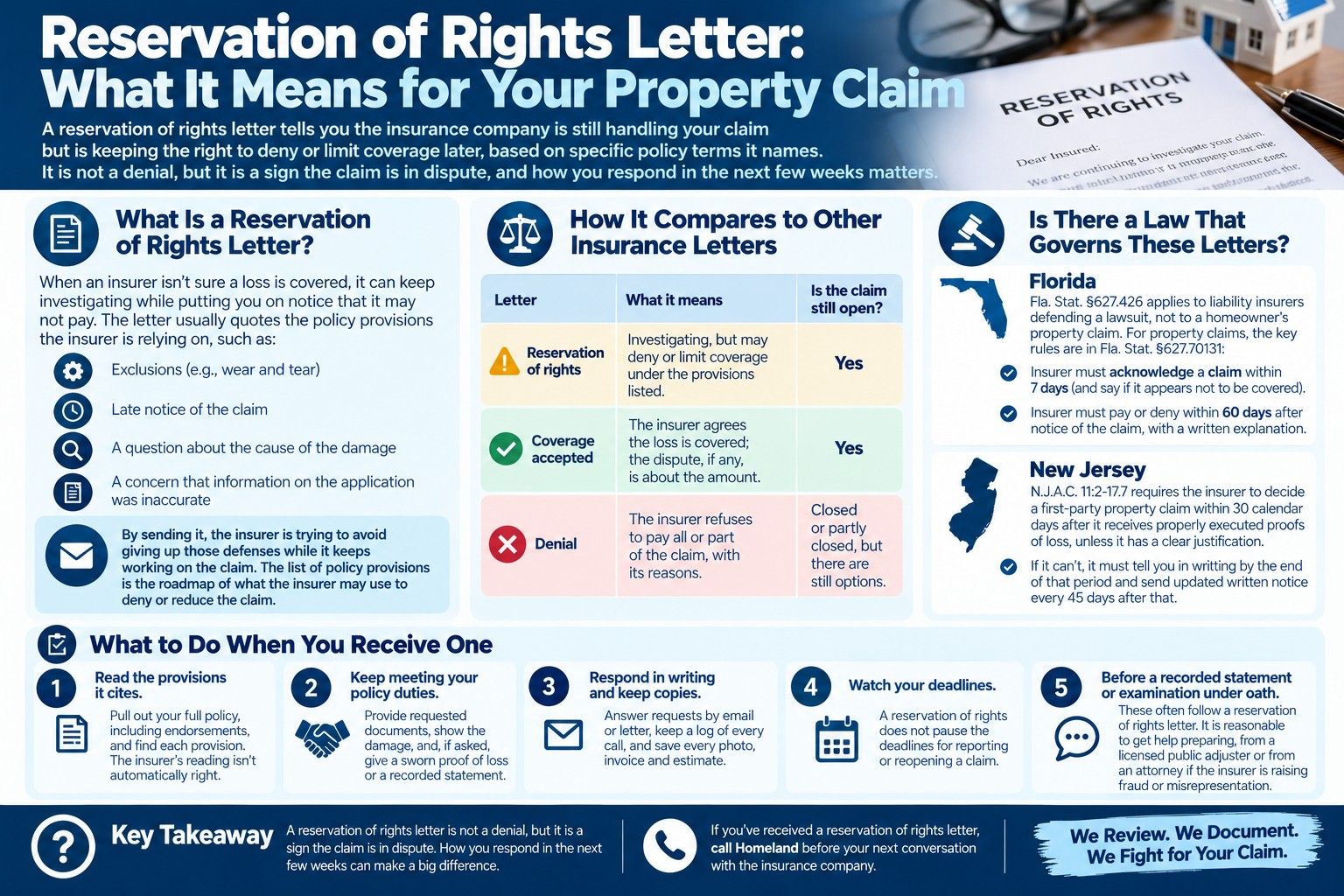
• RFI (request for information)
• reservation of rights
12.3.7 Payment Processing
Involves:
• issuing checks
• mortgage company requirements
• recoverable depreciation rules
• release language review
Understanding this chain allows Homeland to predict where delays or issues may arise.
12.4 Common Carrier Questions — And Why They Ask Them
Carriers are not trying to confuse policyholders.
They are following procedure.
Below are common questions and their internal purpose:
12.4.1 “When did you first notice the damage?”
Purpose:
• establish date of loss
• confirm timeliness
• rule out long-term conditions
12.4.2 “Has there been any prior damage or repairs?”
Purpose:
• prevent duplication of losses
• separate new vs old issues
12.4.3 “Did you perform any mitigation?”
Purpose:
• verify compliance with duties after loss
• determine whether additional damage could have been prevented
12.4.4 “Are there any maintenance records?”
Purpose:
• assess potential wear-and-tear exclusions
12.4.5 “Were you home during the loss?”
Purpose:
• confirm plausibility
• rule out long-term seepage
12.4.6 “Did you have any recent inspections?”
Purpose:
• identify pre-loss documentation
• evaluate structural conditions
Homeland trains clients on how to answer truthfully while avoiding accidental misstatements.
12.5 Carrier Documentation Standards
Carriers typically expect documentation that satisfies:
12.5.1 Causation Requirements
Proof the loss is:
• sudden
• accidental
• consistent with the claimed event
12.5.2 Damage Verification
Evidence must match:
• location
• mechanism
• material
• structural pathway
12.5.3 Reasonableness of Repairs
Carrier evaluates:
• industry standards
• code requirements
• material availability
• labor norms
12.5.4 Completeness of Records
Including:
• invoices
• photos
• estimates
• receipts
• mitigation documentation
Homeland builds documentation stronger than carrier requirements.
12.6 Why Carriers Request Additional Inspections
Carriers may request:
• engineers
• roof inspectors
• HVAC specialists
• moisture mapping teams
• forensic analysts
Reasons include:
• confirmation of cause
• verification of extent
• clarification of discrepancies
• heavy claim volume
• internal quality control
Homeland evaluates vendor reports with equal technical rigor to ensure accuracy.
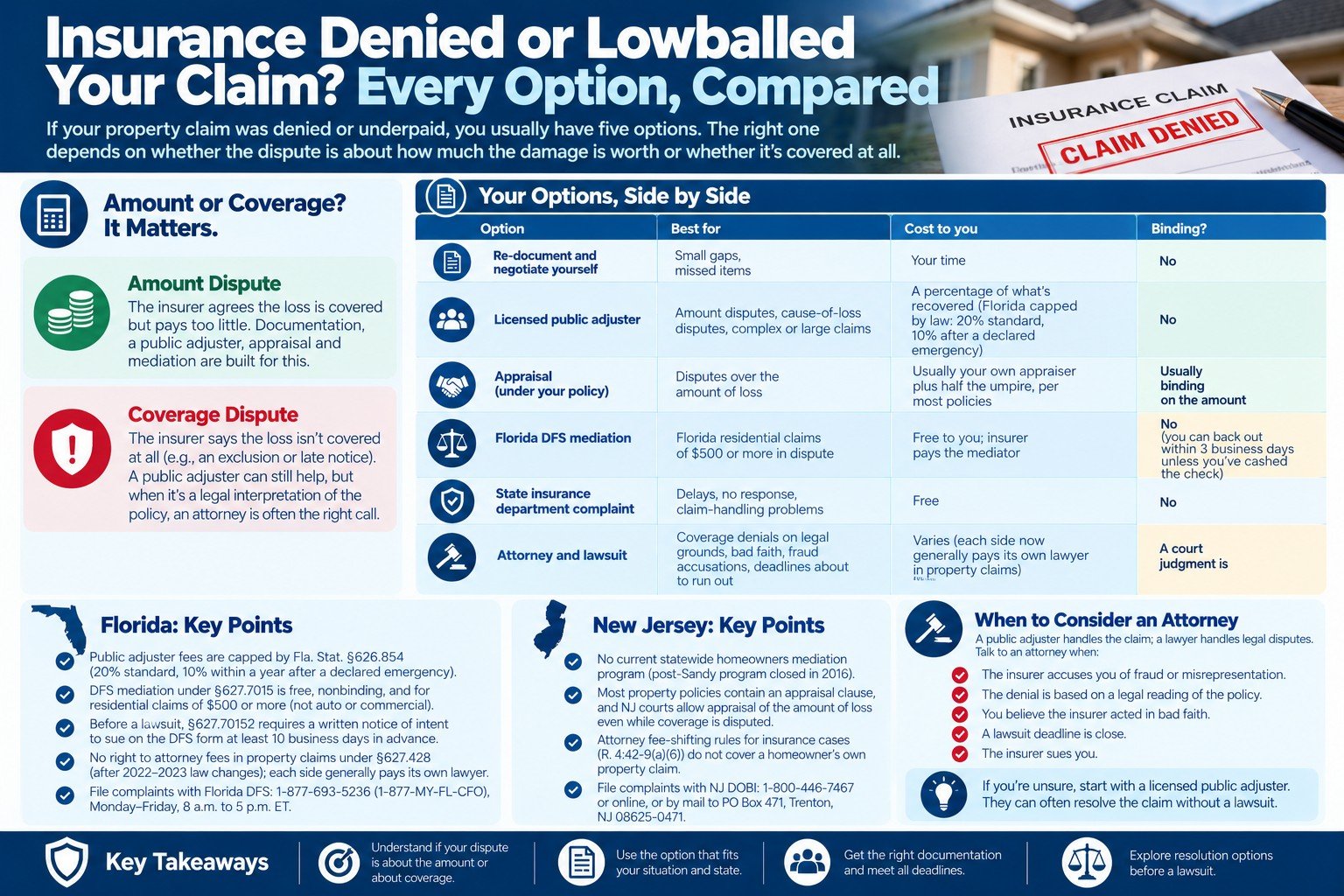
12.7 Why Carriers Issue Denials or Partial Approvals
Denials are typically based on:
• exclusions
• long-term seepage
• wear-and-tear
• insufficient documentation
• policy conditions not met
• non-covered cause of loss
• pre-existing conditions
Partial approvals occur when:
• some damage is covered
• other damage is excluded
• portions fall below deductible
• coverage limits apply
• sub-limits cap payouts
Homeland’s role is to:
• review the denial reasoning
• gather counter-evidence
• challenge inaccurately applied exclusions
• present new documentation
• escalate when necessary
12.8 Carrier Behavior During Catastrophic Events (CAT Claims)
Catastrophic events reshape operations.
Carriers face:
• staffing shortages
• adjuster rotations
• high claim volumes
• compressed timelines
• contractor shortages
• increased disputes
Policyholders face:
• long delays
• inconsistent inspections
• pricing volatility
• limited documentation
Homeland compensates by:
• providing structured documentation
• expediting inspections
• building defensible scopes
• maintaining communication records
• ensuring policyholders are not overlooked
12.9 The National Trend of Carrier Volatility
Across the U.S., carriers have:
• increased deductibles
• reduced roof coverage
• applied more exclusions
• tightened underwriting
• increased non-renewals
• shifted to ACV roof policies
• implemented water damage limitations
Homeland monitors:
• carrier filings
• rate changes
• underwriting bulletins
• structural market shifts
• regulatory updates
This insight informs strategy during claims and renewals.
12.10 Understanding Carrier Estimating Practices
Carriers use:
• Xactimate
• CoreLogic
• proprietary estimating systems
These tools rely on:
• regional pricing
• material cost databases
• labor averages
• construction standards
Homeland ensures:
• accurate line items
• proper sequencing
• correct waste factors
• complete addressing of materials
• code-compliant repair methods
• real-world pricing variations
Homeland scopes often differ not because of “inflation,” but because insurers omit required operations.
12.11 How Homeland Uses Carrier Behavior Knowledge to Protect Clients
Homeland leverages knowledge to:
• anticipate carrier requirements
• prepare documentation ahead of time
• avoid delays
• challenge inaccuracies
• support causation
• ensure scope completeness
• escalate properly
• defend the insured in disputes
Homeland’s advantage is not confrontation — it is preparation.
12.12 Closing Declaration
Insurance carriers operate within a structured, regulated, multi-layered system.
Policyholders operate without comparable resources.
By understanding carrier behavior, Homeland:
• levels the playing field
• prevents errors
• improves outcomes
• guides the insured
• clarifies expectations
• avoids delays
• documents correctly
• protects the rights of the policyholder
Homeland is not anti-carrier — Homeland is pro-policyholder.
This chapter exists to ensure every claim is handled with clarity, knowledge, and expertise.